Grandparents without borders
Migrant grandparents who leave their homes to live in the cities and take care of their children's children are a growing demographic. Liu Zhihua highlights changes they have to face in adapting to their new lifestyles.
In villages across China, grandparents have set aside their dreams of retirement to raise children left behind by their reluctant parents, who migrate to the cities in pursuit of making more money than at home. At a totally different level up the economic pyramid, in urban households, grandparents are now migrating from their homes to take care of their grandchildren in cities hundreds and thousands of miles away - as families scatter across a rapidly transforming China. Their children need to work, and are reluctant to hire a full-time babysitter, either due to distrust of a stranger, preference for family, or financial restraints.
As a result, grandparents, especially grandmothers, shoulder the responsibility of being primary caregivers, when they could be at their leisure after retirement.
But it's not always easy to adapt, especially at what may be a relatively advanced age.
While staying in Shanghai last year to take care of her pregnant daughter, and later, her newly born grandson, Deng Chengying, 55, felt as if she was in a prison.
 |
|
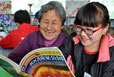
Xiong Jiayi enjoys quality time with his grandmother. [Provided to China Daily] |
The Jingzhou native of Hubei province doesn't understand the Shanghai dialect, but in the community where the family lives, nearly all the elderly neighbors speak only Shanghai dialect.
Deng does have one frequent visitor, a friendly old woman who is an empty nester , but conversation is difficult because she speaks only the Shanghai dialect.
If it wasn't for the traders in the morning market speaking Mandarin, Deng would have few opportunities to speak her native tongue with those in her community.
When her daughter and son-in-law go to work and the housework is finished, she generally stays in the apartment and plays online games.
"I'm so thrilled I just jump if I meet someone whose language I understand," Deng once confided to her relatives at home in Jingzhou during a phone call.
Wu Liujia, 32, a publicity officer at a military hospital in Chongqing, appreciates the sacrifices her parents and grandmother have made to help her.
Wu became pregnant in early 2010. When doctors warned of a possible miscarriage, Wu's retired mother, father, and 82-year-old grandmother set off from Anhui province in the east to Chongqing in the southwest to take care of her and her future son.
While Wu and her husband worked, her mother and grandmother took charge of the housework, and her father, a music lover, played music to entertain the family.
But the climate in Chong-qing is the complete opposite of their hometown. It is hot in summer, clammy in winter, and has few sunny days, which was particularly uncomfortable for Wu's parents and grandmother, especially in winter.
Additionally, after the family moved into a new community they found they couldn't understand the local dialect.
"I felt relieved as soon as they came," Wu says. "But they couldn't fit in and they suffered."
When Xiong Jiayi was 18 months old, Wu's parents and grandmother returned to Anhui, but plan to go back because they want to help out and they miss the kid, Wu says.
Migrant grandparents experience difficulties being in an unfamiliar environment, feel cut off from their friends, and find difficulty adapting to new lifestyles.
Failure to adapt may cause both physical and psychological discomfort, and it is important for the family and community to value their sacrifices, and provide support, experts say.
Lin Hua, 55, from Qianjiang, Hubei province, knows this well from experience.
In early 2006, as soon as her 26-year-old daughter became pregnant, Lin went to Guangzhou, Guangdong province, to offer her help.
Unlike the relaxing life of her hometown, where she plays mahjong most of the day, in Guangzhou she became a full-time caregiver to a baby, in addition to doing the household chores, cleaning, shopping and cooking.
She couldn't understand the local dialect, and also became constipated.
Despite these difficulties, Lin slowly began to enjoy her life in Guangzhou.
She started dance, practiced tai chi, played chess, and watched performances for seniors organized by the community.
As an extrovert, she also made new friends, many of them migrant grandparents.
Most importantly, her daughter and son-in-law treat her with profound respect and love, and make living with them joyful, Lin says.
They often go on holidays together, and her son-in-law is generous with his money.
If there are differences of opinion on how best to raise the child, the couple patiently discuss their early childhood and educational values, and a compromise is reached.
"I feel totally respected and valued," Lin says, adding she has nevertheless heard of difficulties between mothers and daughters-in-law in other families, particularly financial disputes.
She says she was told one daughter-in-law wouldn't give her migrant mother-in-law money to buy groceries."How can someone feel happy treated like that?" Lin says.
Xie Runxin, mother to a 9-month-old boy in Huainan, Anhui province, agrees that young parents should treat their parents with respect, tolerance and an open mind, especially when they are helping raise their children, and are far away from their home comforts and social networks.
Both she and her husband work in the real estate industry and are very busy. When they are at work, her mother-in-law and father look after the boy.
While her father lives in Huainan, her mother-in-law travels by train for seven hours to take care of the baby.
Xie says her mother-in-law is a bit controlling and they sometimes fall out over minor things, such as whether the baby can eat certain foods, but their relationship is generally good.
"I respect her and I'm tolerant. The feeling is mutual," Xie says. "Besides, I know she is not going to hurt the baby. She thinks for it. I understand her."