Going home or going away?
Not everyone in China will celebrate Spring Festival the traditional way this year. Modernization and urbanization have changed how some young Chinese think about this time-tested family holiday. Mu Qian reports.
A family reunion dinner, firecrackers, visiting friends and relatives, handing out red envelopes, and putting up couplets around the house used to be part and parcel of Wang Lei's Lunar New Year celebrations at his home in the Henan province countryside. But not this year. Instead of returning home, the 26-year-old Beijing cellphone salesman will travel with friends to Hunan province during the upcoming Lunar New Year to have some fun.
He will set out on the first day of Lunar New Year, also known as Spring Festival, and return to the capital before the holiday ends, along with everyone else who has a hectic work schedule.
 |
|
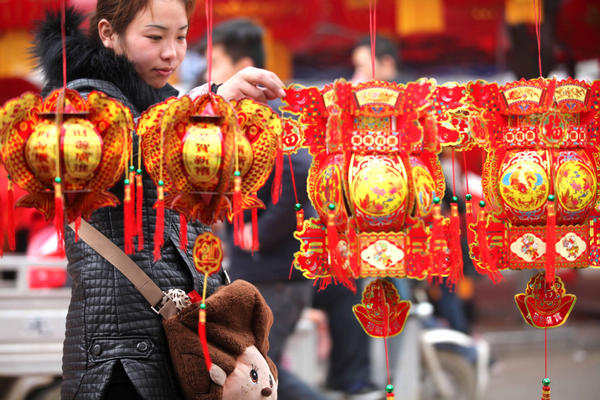
Shopping for decorative lanterns is popular now, since the New Year celebration ends with the Lantern Festival. [Photo/Xinhua] |
"The Lunar New Year holiday is a good time to travel, as there are fewer tourists," he comments.
Wang says Lunar New Year is not as atmospheric as it used to be in his hometown. Most of the young farmers have left to become migrant workers in more developed eastern areas, and many return only every two or three years.
As for Wang's family, his parents will spend this Spring Festival with his sister in Xiamen, Fujian province, while Wang intends to see his parents in the summer instead.
Leisure travel has become a popular activity around this time after it became a "golden week", or seven-day public holiday, in 1999.
Li Xiang, a young office worker in Beijing, traveled to Guangxi Zhuang autonomous region during the Spring Festival holiday two years ago.
"I wouldn't say it's the best way of celebrating the occasion, but the holiday is the longest of the year for many people to travel," she says.
Li often wavers between vacationing on her own, or seeing her parents in Jilin province during the Lunar New Year. This year she has decided to do the latter. "I love traveling, but I also want to be with my parents," she says. "I wish I could compromise by traveling with them."
Li is planning to do just that next year. Although her parents are not used to celebrating the festival in this way, Li says she intends to persuade them and believes they will enjoy it.
Lunar New Year is traditionally a time for family reunions, just like Christmas is in the West. Originating in the Han Dynasty (206 BC-AD 220), it takes place around the turn of the year in the Chinese lunar calendar.
Held during the slack season for farming, it traditionally consists of a long series of rituals and activities. It formally starts on Lunar New Year's Eve and ends with the Lantern Festival that falls on the 15th day of the first lunar month.
- Spring Festival travel snooze
- bor shortage expected to hit after Spring Festival
- Labor shortage expected to hit after Spring Festival
- Spring Festival travel rush starts in Dalian
- Make decorations and snacks to greet Spring Festival
- Make decorations and snacks to greet Spring Festival
- Prices for Chinese liquor drop ahead of Spring Festival