China promotes Spring Festival traditions by law
|
 |
|
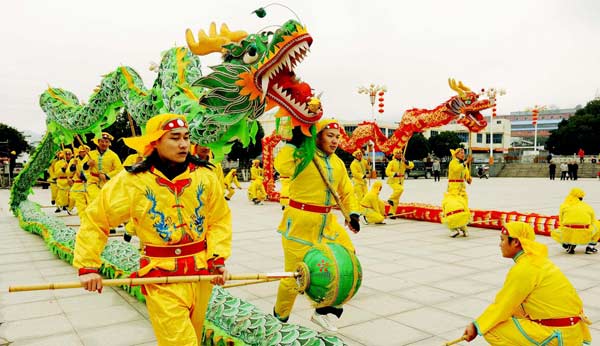
Performers rehearse dragon dance for the upcoming Spring Festival in Dexing, East China's Jiangxi province, Feb 6, 2013. [Photo/Xinhua]
|
SHANGHAI - Yu Jie is one of the lucky ones. The 21-year-old waitress of a hotel in Shanghai boarded a train early Thursday on her way home hoping to arrive before Sunday, the Spring Festival, in time for a family reunion.
"It was so hard to get a train ticket. I had to divide my journey into two, from Shanghai to Wuhan, capital of Hubei Province, and then from Wuhan to Yueyang, a city in Hunan Province," said Yu, who is one of millions of people heading home to visit their parents during the Chinese Lunar New Year.
It has been a tradition in China that those living apart from their elderly family return home during the festival period.
To further encourage this, the Law of the People's Republic of China on Protection of the Rights and Interests of the Elderly was revised with a law article in December.
To become effective on July 1, 2013, the revised law stipulates that family members living apart should often visit their senior family and employers should guarantee employees' rights to vacation and opportunities to visit their senior family.
Shen Guoming, an expert with Shanghai Institute of Legislation, said the proposal encouraging people to visit their family was first initiated by the public and is included in provincial regulations and finally become an article of a national law.
However, goodwill cannot only be realized by law.
China has 250 million migrant workers and most of them have one opportunity to go home during the Spring Festival. Others may not have a chance during the whole year.
There will be more than 3.4 billion passengers trips during the festival this year, up 8.6 percent from 2012.
However, "going home" has become a national puzzle, due to Chinese companies' employment rules, railway capacity, weather and even the online ticketing system.
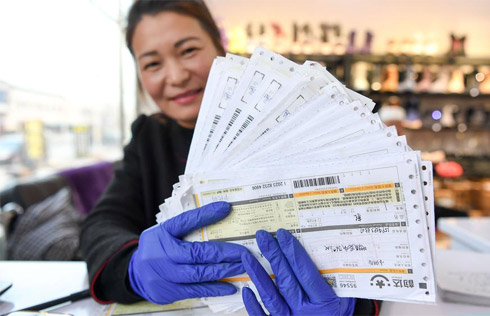
Despite getting her ticket, Yu said, "This year, I tried to buy a train ticket on the Internet, but got nothing. Then a colleague tried more than 100 times to call the ticketing phone number and finally bought me a ticket."
She described herself as one of the "lucky ones."
Because of the online ticketing system, Yu is having to go home alone, as her friends did not get tickets on the same train. "We have to go home separately. Some have had to spend 1,000 yuan for a flight, which equates to half-a-month salary," she said.
At her work, only half of the hotel's 100 employees will go home before New Year's Eve, while the other half will have to wait for after the festival.
The good news is that the hotel owner also arranges the opportunity for its staff to visit their families every summer.
Her work's "two home visits" system is advanced but rare for hotels in big cities like Beijing and Shanghai.
Yu told Xinhua that because of the hotel's system, she and her colleagues would rather stay working there than another place with a higher salary, but have less opportunity to go home.
"The ideal frequency to go home would be once a week. It might be possible if I worked in a big city of my home province but it is impossible being in Beijing or Shanghai," she said.
Yu said she spends more than 200 yuan a month on phone calls to her family.
The hotel's home returning system is in accordance with the law article as well as social morality and conscience, Shen Guoming said.
"The legislation aims at proposing home returning. Actually we hope that the power of social morality will stand out as the law cannot guarantee everything," he said.
As well as people finding it hard to get home, the country also has millions of empty-nesters and children left behind by their parents who seek jobs in cities.
According to statistics from the Ministry of Civil Affairs, more than half of Chinese families are empty nests, and the number reaches 70 percent in big and mid-sized cities. There are more than 40 million empty nesters in rural areas.
One single law cannot solve China's dilemma and thorough reformation is needed, Shen said.
Experts also said that the elderly should have faith in the younger generation when it comes to problems of material supporting and spiritual care.
"On the morning of the Chinese Lunar New Year, I will give my parents each one red envelope(usually a monetary gift)," Yu Jie said excitedly.
Yu said the happiest thing for her is that she can give her parents more than 10,000 yuan a year now. "All of it is saved from my daily expenses. I feel much better when I go home to eat and chat with my parents and brother," she said.
- 12th Lantern Festival in Guxumen, Suzhou
- Final polish for Spring Festival Gala
- Small bites: Spring festival & Valentine's
- Lights up for Spring Festival
- Special: 2013 Spring Festival
- Family feast gives festive feeling
- Spring Festival 2013 Sanfang Qixiang Events
- Spring Festival celebrations held in Austria