Great snakes!
 |
|
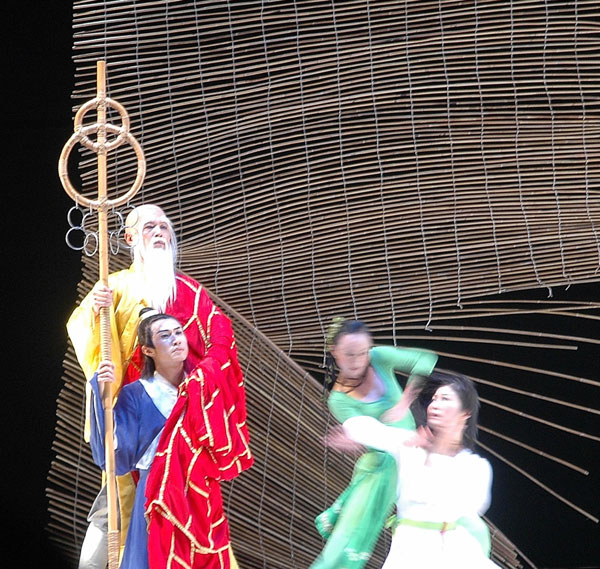
White Serpent Tale, played by Cloud Gate Dance Theater of Taiwan, is an adaptation of the famous Chinese legend, Madame White Snake. Zhu Yinwei / for China Daily |
Indeed, if you're bitten by a snake - presumably not a poisonous one - for the next decade you'll tremble at the sight of a rope, or anything that vaguely resembles a snake.
There is an ancient tale of a man who spots a snake in his glass of liquor. It turns out the wriggly thing was the reflection of a bow hanging on the wall. The yarn has since been immortalized as a phrase for unfounded panic.
Contrary to some cultures where the snake is perceived as a steadfast defender, in the Chinese lexicon it is enshrined as a subject and object of fright.
In calligraphy, however, the snake is not portrayed in a negative light. A serpentine brush stroke is to be marveled, not quivered, at - and that refers to a snake that's flying or scurrying away.
Very often, the snake comes with its nobler peer, the dragon, in such descriptions. However, one ancient calligrapher painted a realistic snake on a scroll and, on a whim, added a foot to the legless species, thus becoming the archetype of redundancy. Never mind that some species indeed have a pair of vestigial claws. But in this story, it's the painter, not the snake, who is the butt of derision.
For all the snake-related idioms, China does not hold a candle to Indian mythology when it comes to snake references. Likewise, Egyptian, Greek, Christian and many other cultures have images of the snake more colorful than ours.
The Chinese snake is not as rich in connotation and has not spilled over into the visual arts. We do not have a deity sitting on a coiled python; the Buddhist concept of reincarnation has not been compared to the shedding of snake skin; our female monsters do not sport a crop of snakes for hair; and a snake is not the cause for carnal temptation. (The fox is the closest to that symbol, but it epitomizes female seduction rather than the lure that brings man and woman together.)
All right: Nuwa, the Chinese goddess who mended the broken sky, has a human head and a snake body. And in Journey to the West, a.k.a. The Monkey King, there is a nine-headed snake, which surely gave the CGI artists a field day.
While overwhelmingly repulsed by the snake, Chinese sentiments for the 2013 zodiac animal can be more complex, varying with time and locality. In Fujian province, the snake is held in a god-like position. It is not to be killed if found in a home, but removed gently into the wild. It is definitely not to be eaten as food. Some say they love the tickling of a python slithering around their body. At a mid-year festival, a parade is organized in which every participant holds a snake, which is supposed to bring them peace and harmony.
A branch of ethnic Li in Hainan province regards the snake as their ancestor. There are several folk tales of humans and snakes marrying each other. If a snake is found near a tomb, it is considered the apparition of the dead person. In Guizhou province, the Dong ethnic costume features myriad snake motifs, and they even motion like a snake during a prayer ritual.
These are a few examples of pagan worship for the snake that remain after thousands of years of demonizing it with a glossy veneer of civilization. In many cases, the snake either morphed into the more auspicious dragon or simply became an embodiment of malice and immorality.
One ambiguous similarity remains between East and West, though. The snake is a symbol of sexual passion in some cultures. In China, snake wine, made by infusing whole snakes in grain alcohol, is believed to have rejuvenating or even aphrodisiac power. It could be that the sinuous movements of the cold-blooded vertebrate conjure up the act of sex, which is handy in a nation of florid metaphors.
As a gourmet dish, the snake is much valued in the Middle Kingdom, especially in southern China. For those who believe in traditional Chinese medicine, each part of the snake is a "treasure", so to speak. Snake bile is said to be a remedy for many ailments, including rheumatism. Its venom is made into drugs for pain, poison and blood clots.
But Cantonese people eat snakes mostly for their taste. There is a famous dish called "Dragon and Tiger in Battle". It's actually a snake and a cat cooked but preserved as they were in life. I've heard stories that it was served to distinguished guests from Western countries, who, upon taking one look at it, promptly fainted.
A decade ago, there was a theme park in a suburb of Guangzhou that was devoted to snakes. It was a zoo full of all kinds of snake species. As a publicity stunt, the owner put his daughter, probably a snake charmer, into a cage with hundreds of snakes, where she stayed for so long it broke the Guinness Record - or so it was claimed.
Afterwards, a group of local celebrities were invited to a banquet, where a dozen courses were served, each one a dish of snakes but cooked in different ways.
I tagged along and swore I would never touch or eat a snake. But I was encouraged to break my personal prohibition out of courtesy for the host. It turned out snakes were not that delicious, at least to me. The meat was rough and chewy, hardly as tasty and delicate as eels, which my friends said I should pretend they were.
The most famous Chinese legend involving snakes puts a decidedly positive spin on their portrayal. Madame White Snake has been told in myriad operas, movies and television serials. The basic plot goes like this: The spirit of a white snake transforms herself into a beautiful maiden, who goes by the name Bai Suzhen and falls in love with Xu Xian, a mortal living by Hangzhou's scenic lake. They later get married.
Before they can live happily ever after, a monk named Fahai, who used to be a terrapin spirit, tricks Xu Xian into coercing his wife into drinking realgar wine, which reveals her true form as a snake. Xu Xian is so scared that he falls ill. Bai flies to Mount Emei and steals a medicinal herb that revives her husband.
- Unraveling the myths and charms of snakes
- Luxury brands snake their way into China
- Snakes, alligators stolen from Australian zoo
- EU debt crisis is a snake with nine heads
- Nepali man bites snake to death in revenge attack
- Thousands of released snakes frighten villagers
- Two-headed snake on display in Ukraine zoo