Carving steadily being resurrected as an art form
 |
|
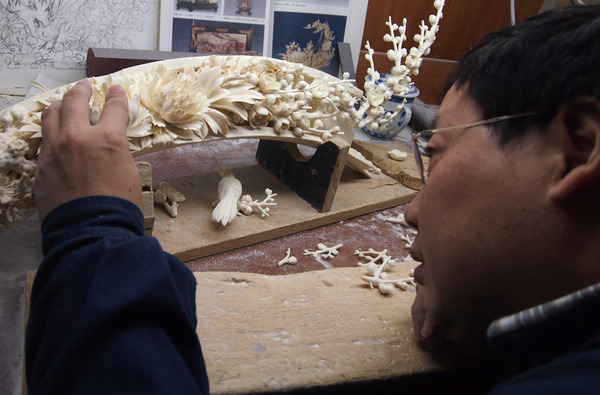
An artist carves a piece of ivory at the Beijing Ivory Carving Factory in January. [Yang Yao / China Daily] |
In 2009, Guo Chen became the first employee recruited by the Beijing Ivory Carving Factory in more than 20 years.
The factory, as well as 35 others of its kind across the country, had almost closed down since the international ivory trade ban in 1989.
A 24-year-old college graduate who majored in Western sculpture, Guo said he never thought he would one day earn a living by carving ivory, but he has found it a rewarding career.
"Turning elephant tusks into art gives me a strong sense of achievement," he said. "I see the piece as a respectful continuation of the elephant's life."
In 2009, the year Guo graduated from Beijing University of Technology, China legally imported 62 metric tons of ivory in a one-off sale from four African countries - South Africa, Botswana, Namibia and Zimbabwe - brokered by the Convention on International Trade in Endangered Species of Wild Fauna and Flora, commonly known as CITES.
With new material stocked in the warehouse, the ivory factory resumed its program of recruiting apprentices. Guo was one of eight newcomers. Before they arrived, there were only five skilled carvers in the factory's workshop, three of whom had passed the age of retirement.
"I was deeply fascinated by the exquisite art the first time I saw it," Guo said, adding that, for him, carving ivory is a big challenge as the skill required is very different from what he learned in school.
The art is unique, said Luan Yanjun, 57, who is retired but still mentors apprentices at the factory.
In addition to common techniques such as single-line intaglio carving, round carving, relief carving and micro-carving, there are three other unique skills, he said: Fretwork, cleaving-plaiting and inlaying-dyeing.
It takes on average three years of apprenticeship to learn, he added.
Luan started his apprenticeship at 17. He said that only through practice can one become a master. But after 1989, chances to practice were limited because the stockpiles of tusks ran down, and artists like Luan found their skills getting rusty.
Because of the unique skills of ivory carving and the loss of skilled carvers, ivory carving was listed as a national intangible cultural heritage in 2007.
With 40 years' experience in the business, Luan said ivory carving has long been part of Chinese culture - it used to be a tradition in the royal families thousands of years ago.
Luan disputes accusations that the carvers are indifferent to the fate of the endangered animals in Africa.
"This ancient art never intended to harm elephants. We care (about endangered species), too," he said.
"If elephants become extinct, we will have no material to carve, and I'll be jobless again."
Even though the factory now has resources, it has to use them frugally because the quota of tusks it is assigned is small. "Every year, we can use only 629 kg, no more and no less," manager Xiao Guangyi said.
To conserve the ivory, beginners practice only on wood, he said.
The factory has also developed a way of engraving on rotted tusks. Luan pointed at a piece of work depicting a lotus flower with raindrops on the leaves. "The corrosion and fissure were in exactly the right place for a lotus," he said.
The factory, trying to keep the art form from fading into history, has been actively involved in the elephant conservation projects in Africa.
Together with 30 other ivory-carving enterprises, it has put money into the International Fund for Elephant Conservation to subsidize eight programs in Africa and Asia every year.
"We know that the two worlds depend on each other," Xiao said. "We cherish the elephants in Africa. Only by protecting them can our sculpturing be developed."
Main destinations
Ivory-carving artists like Luan say they believe the art, which dates back thousands of years and has three distinct styles, deserves a chance to continue living. He said his factory can represent only the Beijing style of ivory carving.
Beijing, Shanghai and Guangzhou are the three main sculpturing destinations, each with different characteristics.
Categories of ivory sculpture include characters, animals, flowers, landscape and micro-carvings, he said.
But the factory, which was founded in 1953 and once employed 800 people full time in the early 1980s, was almost closed in the 1990s when it ran out of ivory.
"The majority of carvers transferred to other industries," Luan said. "What a huge waste of talent."
As manager of the factory, Xiao Guangyi said that 10 to 15 years are needed to restore the craft by training new carvers.
Xiao said that they are now doing this business for cultural preservation, and the profit is low.
Lin Zhao, an industry insider from Guangzhou, where carvers are famous for being able to carve ivory balls of up to 30 layers, said an eight- to nine-layer southern-style ivory ball can cost 7,000 to 8,000 yuan ($1,120 to $1,280). For 10 to 12 layers, the price is 100,000 to 200,000 yuan. For a piece with more than 30 layers, the price is 300,000 yuan.
"Compared with other ornaments, what we earn is very little," he said. "The price of ivory products depend on the art, not the material."
But no matter how hard the business is, factory manager Xiao said his workshop uses only legal materials, and current regulations stipulate that only factories and stores approved by China's wildlife watchdog can be in the business.
An adequate supply
As environmental protection organizations and Chinese ivory carving artists both want to prevent the extinction of elephants, some researchers are hoping for an improved trade system that can stop poachers and simultaneously support an art that was once on the verge of extinction.
"The tusks from elephants' natural deaths are sufficient to supply the sources in the Chinese market," Cao said.
Every year, China assigns a quota of 5 to 6 tons of legal ivory to the carving industry, he said.
"From our survey and investigation of the stores, the supply is adequate to satisfy demand," Cao said. "We want ivory carving in China and elephant protection in Africa to both be sustainable."
Brendan Moyle, an economist at Massey University in New Zealand, said in a report on his visit and investigation in China that the legal ivory market in China is a small industry, with a productive output limited by the lack of qualified carvers.
"It's not a competitive market, as entry is restricted and firm numbers are low," he said.
Although many would prefer to see a strict, all-out ban on the ivory trade (including the Kenyan government, which in 2011 destroyed more than 70 tons of tusks to send a signal to poachers), Moyle feels it would be better to implement a regulated trade system that guarantees a sustainable and ethically sourced supply of ivory.
This way, the revenue from the tusks of elephants that die naturally could go directly toward preservation efforts, Moyle said. "The more elephants they have, the more tusks, and the more they can spend on protection. And the more protection they have, the more tusks they'll produce," he said.
"If consumers switch from the illegal market to the legal one, they'll reduce demand for the black-market tusks. That will reduce poaching."
"Legal ivory trade is not the cause of elephant poaching," he said. "We need to focus on the real cause of poaching."
yangyao@chinadaily.com.cn