Comments
  Print
Print  Mail
Mail  Large Medium Small
Food safety authorities announced on Friday that plans to create new, unified national standards on bottled drinking water are under way?- a move that experts believe is crucial to ensure the product's safety.
The National Health and Family Planning Commission is speeding up its consolidation of current standards on bottled water, and new national standards will be published, China National Center for Food Safety Risk Assessment said in a statement.
The quality of bottled water has recently caught public attention, after one of China's largest producers was found to be using a provincial government's water standard instead of the much-stricter national ones.
About one-third of the bottled water sold in Beijing is produced in accordance with standards created by bottled-water companies themselves, according to a report in the Beijing News.
"A unified national standard is necessary, and it must cover all mandatory indexes of bottled water," said Dong Jinshi, a food safety expert in charge of the International Food Packaging Association.
Bottled-water companies in China adopt a variety of water standards, including national standards made by different ministries; standards made by local governments; and those made by the companies themselves. This creates confusion among the public and makes it difficult for the food authorities to supervise quality, Dong said.
A latest case to mirror the standards chaos involves Nongfu Spring Co, one of China's largest bottled-water producers. The Beijing Association for Barreled Drinking Water, an organization affiliated with the Beijing municipal government, suggested that the Zhejiang province-based Nongfu Spring on Thursday withdraw its barreled water from the Beijing market.
Water stored in barrels, that usually have a capacity of 19 liters, is provided for drinking at home and in offices by a number of companies.
The association said in a statement that the reason for suggesting the withdrawal of Nongfu Spring barreled water is that the products have been labeled with a Zhejiang province standard, which is a serious regulatory violation, and the company did not provide any quality certificate or quality report on barreled water to the Beijing authorities.
Earlier, Nongfu Spring was accused of adopting water standards made by the government of Zhejiang, which is much lower than the updated national standards for bottled water, although its bottled water and barreled water are sold all over the country, with a domestic market share of more than 20 percent.
For example, the permitted amount of toxic arsenic is no more than 0.01 milligrams per liter in the national standard, but the allowed maximum amount is 0.05 mg/liter in the Zhejiang standard followed by Nongfu Spring.
Food safety standards made by local governments should be stricter than national standards, according to the law.
Although Nongfu Spring did not deny that it follows Zhejiang standards, it later released several test reports to prove the quality water of its products is higher than national standards.
Qu Sheng, a dealer of barreled water in Beijing's Haidian district, said he has not been informed by the Beijing Association for Barreled Drinking Water to withdraw Nongfu Spring barreled water on Friday, but he said he has not sold the brand for half a month.
"About two weeks ago, Nongfu Spring informed me they could not sell me barreled water any longer, without giving me any reason," he said. "But all other brands of barreled water are being sold normally."
Wang Kuo, a sales manager at a State-owned company in Beijing, said: "I have heard news about bottled water of Nongfu Spring, and was quite upset."
"I always bought water of Nongfu Spring, and had full confidence in it. I did not realize it is using a local standard," he said. "I may not buy it in the future."
China has more than 5,000 standards on food quality and hygiene, which were formulated by different government departments, and some of them overlapped while some contradicted one another, said Chen Xiaohong, vice-minister of the former health ministry.
The government will finish clarifying existing food standards by the end of the year, after which proposals will be made on whether the standards should continue, be integrated or abolished, according to a State Council circular.
Shan Juan contributed to this story.
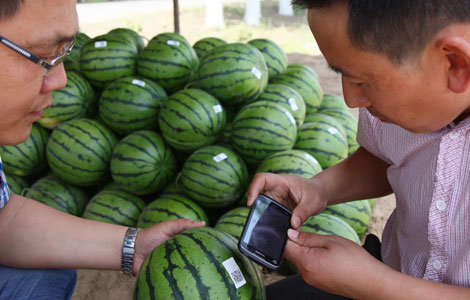
 Watermelons now come with scannable data
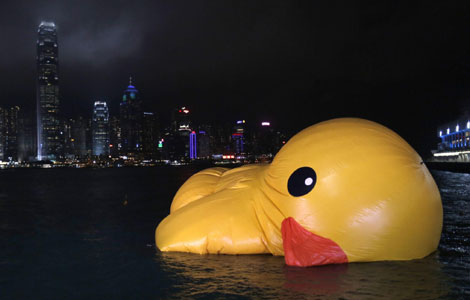 Rubber Duck falls into Victoria Harbor
 Car wreck over car parts quality claim
 Gales, hailstorms batter villages in SW China
 Ram with artificial heart sets survival record
 The future of wearable computers
 Anniversary quake drill jolts students
 15,000 tour memorial hall on quake anniversary
Copyright 1995 - 2010 . All rights reserved. The content (including but not limited to text, photo, multimedia information, etc) published in this site belongs to China Daily Information Co (CDIC). Without written authorization from CDIC, such content shall not be republished or used in any form. Note: Browsers with 1024*768 or higher resolution are suggested for this site.
License for publishing multimedia online 0108263 Registration Number: 20100000002731