Comments
  Print
Print  Mail
Mail  Large Medium Small
 |
|
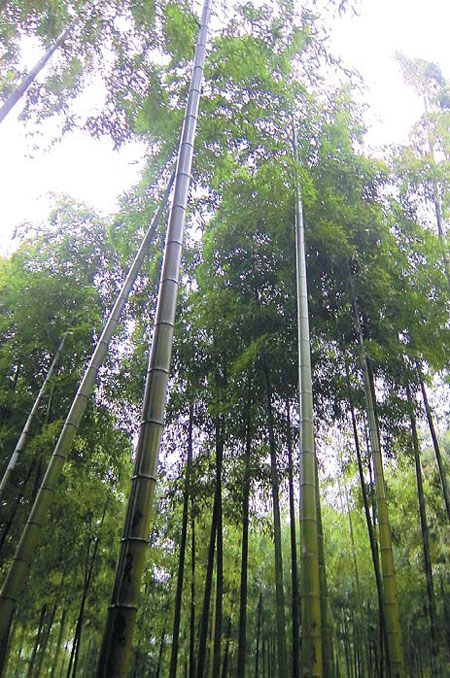
Zhejiang province produces much of China's bamboo, as a global industry grows around "the next super material". Erik Nilsson / China Daily |
Cheng Feng earns about 20 million yuan a year, employs 70 workers and its factories cover about 1.33 hectares.
"Bamboo is harder and more elastic than wood, but it is cheaper," he says.
"It has made Anji rich. The global market is growing. It benefits the farmers most. And my business is getting bigger."
Anji was not only the first place in China to industrialize bamboo but also has developed its most extensive tourism industry around the grass.
Bamboo lures more than 500,000 tourists to the area a year, generating 500 million yuan for the county. They come to hike the forests, eat bamboo in rural restaurants and buy bamboo handicrafts, Tianhuanping's deputy mayor Ye Yan says.
Many visitors come to see the filming sites of such blockbusters as Crouching Tiger, Hidden Dragon, The Banquet and The Matrimony. There's even a small museum dedicated to films shot in Anji's bamboo forests.
And the bamboo industry poses little risk to the environment that supports its plantations, Xuan says.
Manufacturing products with it requires few chemicals.
"Bamboo flooring doesn't use the toxic substances other flooring does," Zhejiang Bamboo Industry Technology Co Ltd general manager Xu Guowen says.
Xu says the factory workers earn more per square meter - about $20 - than the factory, which keeps about $5-10 of the $60 sale price after dealing with wholesalers and shipping costs.
Xu's enterprise's parent company Yoyu Bamboo exports mostly to the United States and Europe.
"The flooring is cheaper than wood, 100 percent stronger than oak and much denser," office manager Tong Wangjing says.
The company also produces traditional Chinese furniture using red bamboo and contemporary furniture for offices, homes and hotels. It employs more than 1,000 people in its five factories.
"Many people are surprised by what we make with bamboo, which would usually be made of plastic," Tong says.
Tong's career has also advanced with Anji's bamboo industry.
She earned 15,000 yuan a year at the company a decade ago, and now earns more than 100,000.
"I was a teacher but saw the bamboo industry taking off, so I switched jobs," she says.
"Here, I can learn about bamboo and move forward with its development."
She says local people have used bamboo since before she was born.
"When I was a kid, farmers made everything of bamboo - chopsticks, pot covers, furniture, baskets, farm implements, toys, floors - you name it."
Xuan recalls that even rich people had bamboo roofs because it was a matter of life and death.
"We'd get flash floods," he recalls.
"People would grab their bamboo roofs and float away, like they were rafts. If your house had shingles, you'd drown."
Anji resident Chen Yunchang was among the first Chinese to make bamboo-processing machines.
"Everything was done by hand before we industrialized in the early '90s," he says.
He still builds machines but now for his own factory, which produces blinds, matts and rugs.
Xue Qiang Products, which he founded in 2000, exports to the US, Europe, Japan and South Korea, bringing in roughly $120,000 a month.
"More people are buying bamboo products as people are thinking greener," he says.
The 400 workers in his 10.67 hectares plant earn an average of 2,400 yuan a month.
Manager Chen Yanfeng says this means he can stay in his hometown.
"We don't have to become migrant workers," says the 33-year-old, who has worked at the plant for 14 years. He earns about 10,000 yuan a month and has innovated upon several machines.
His colleague, 28-year-old manager Guo Qin, agrees.
"Without the industry, I'd have to work the fields like my parents," says Guo, who earns 10,000-20,000 yuan a month.
"I can study bamboo machinery here."
Anji is not only China's main bamboo production base but also the largest producer of bamboo manufacturing machines.
Anji Jitai Machinery Co Ltd manager Liu Zhanming says his company grew 20 percent annually from its 2003 founding until 2008.
Its 38 workers produce dozens of types of machines in its 1.2-hectare factory.
Many are exported to Africa, South America and Southeast Asia.
"We are a small enterprise, but we have a big impact on the world," he says. "About 2.5 billion people live in bamboo forests, and the market will grow. As it does, the machines will become greener."
Another up-and-comer in the bamboo sector is the textile industry.
Tan Zhuzhuang is Anji's main bamboo textile brand.
"Bamboo is almost as soft as silk," manager Du Dongliang explains.
"It breathes better than other materials and kills bacteria. So, it's cooler in summer and doesn't stink if you sweat. It's also three to six times more absorbent than cotton."
That said, bamboo cloth is about 20 percent more expensive than cotton.
But it's a long commodity chain. It takes 17 steps and 100 days to turn a bamboo pole into yarn.
Chen Yanfeng, the Xue Qiang Products manager improving on machines, believes Anji's and China's future bamboo alchemy shines.
"I think our situation will only get better as processing technology advances," he says.
 Watermelons now come with scannable data
 Rubber Duck falls into Victoria Harbor
 Car wreck over car parts quality claim
 Gales, hailstorms batter villages in SW China
 Ram with artificial heart sets survival record
 The future of wearable computers
 Anniversary quake drill jolts students
 15,000 tour memorial hall on quake anniversary
Copyright 1995 - 2010 . All rights reserved. The content (including but not limited to text, photo, multimedia information, etc) published in this site belongs to China Daily Information Co (CDIC). Without written authorization from CDIC, such content shall not be republished or used in any form. Note: Browsers with 1024*768 or higher resolution are suggested for this site.
License for publishing multimedia online 0108263 Registration Number: 20100000002731