The forgotten town of black gold
Preparing for the future
 |
|
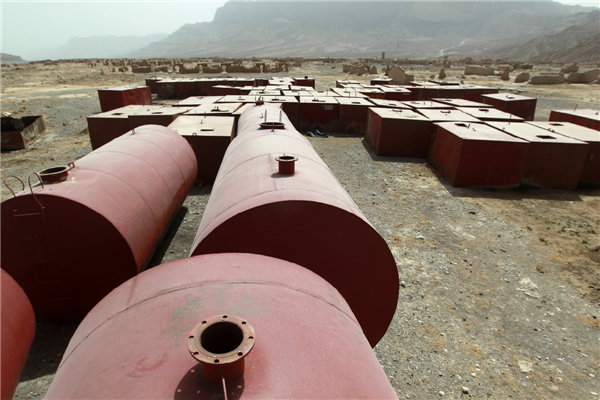
Empty oil containers are scattered around the once busy settlement. [Photo by Cui Meng / China Daily] |
The fates of 10 of China's most-typical oil cities, large and small, are inextricably linked with the natural resources hidden underground. Once the resources are exhausted, which is inevitable, the cities must be prepared to change to avoid following the footsteps of Yiqikelike.
"Karamay is a typical oil city in Xinjiang. At the moment almost all its income comes from oil-related industries. Although the local oilfields could be viable for another 100 years, the city must be prepared for the day when there is no more oil," said Chen Xinfa, the mayor and general manager of PetroChina's Xinjiang subsidiary.
The depletion of resources is a fact all oil cities must acknowledge and will experience. Therefore, action must be taken to help the next generation, said Chen. Most of the 390,000 residents of Karamay, Xinjiang's second-biggest city, are oil workers and their relatives.
The local economy must be transformed from one based on the extraction of resources, therefore new specialties must be developed. In Karamay, for example, great hopes are being pinned on the international information technology industry.
The city, which sits in the middle of the Gobi desert, is also attempting to develop its tourism potential. "Tourists are curious about how oil is produced and they may find the sight of more than 20,000 rigs on the vast Gobi desert quite attractive," said Hu Jun, deputy director of the city's tourism bureau. A drop of cruel oil, sealed in a crystal bottle, has become one of the hottest souvenirs among Karamay's visitors.
Wang said the decline of Yumen in Gansu province provided a harsh lesson in what not to do. In 1957, Yumen became China's first oil production base, delivering more than 87 percent of the country's oil at the time. However, when the oil and natural gas reserves began to run out in the late 1990s, more than 25,000 workers, plus 60,000 of their relatives, left the old city. The city government finally moved to "new" Yumen in 2003, leaving most of the old town deserted.
In new Yumen, 70 km from the original city, more than 1,100 wind turbines have been installed and wind power has replaced oil as the dominant energy source.
Wang hopes Karamay won't become the next Yumen, but stressed that the city faces a similar threat. "During the 1990's, people began to worry about the oil reserves and many chose to leave. Meanwhile, PetroChina Xinjiang Co was in the process of moving its headquarters to Urumqi, the capital of Xinjiang. Karamay means "black oil" in the Uygur language. The city was built in the desert, but without oil, there's no point in the company staying on in the desert where the cost of living is very high. That's the risk we face now," he said.