The middle-class trap
World-watchers say China's expanding middle class will become the most influential bloc on this planet very soon. But in the meantime, they are the ones who have to struggle most with new expectations, higher benchmarks and also battle ingrained lifestyle traditions. Liu Wei takes a closer look.
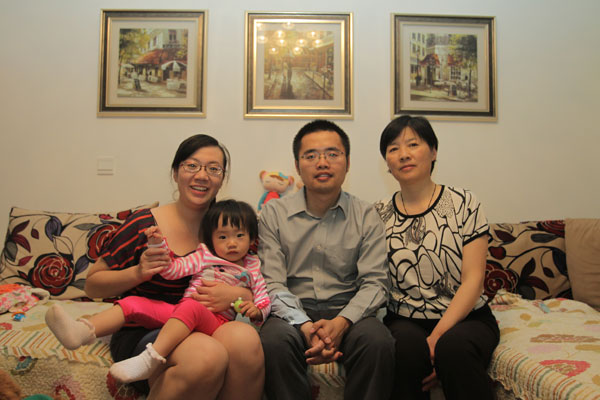
Han Lin has not spoken to his father in two months. Part of the reason is the old man wants to take his 1-year-old granddaughter back to Xuzhou, Jiangsu province, so he can look after her better, but the city is a four-hour train ride away from Beijing, and his son had flatly refused. While the situation may be unfamiliar to people living in the United States or United Kingdom, Han's dilemma is very common in China, especially among the growing numbers of the so-called middle class. And this is only one problem they face.
A recent report by The Times of London describes the Chinese middle class as "on their way to becoming the most powerful social bloc on the planet". The Wall Street Journal quoted statistics from McKinsey & Co, which defines this group as those with annual disposable incomes of between $16,000 and $34,000.
Han, an IT engineer with a US company, and his wife Qian Jin, an accountant in a private domestic enterprise, were startled at the suggestion that they fitted into this category.
"Middle class? Call me middle-class when I have at least two houses and a Beijing hukou," says Qian. A hukou is a permanent household registration in the city, which allows the resident full privileges in housing, education and health services.
 |
|
|
Housing has become the most important issue for most urban Chinese families, closely followed by their children's education.
The price of a 100-square-meter apartment around Beijing's Third Ring Road, about 10 km from the city center, has risen to four times its price in 2005.
Han, 32, bought his 90-square-meter apartment in 2008.
His suburban community has no major hospital or shopping mall, and he drives an hour each day to his job in the city center. Yet, he considers the house his wisest investment in Beijing. He bought it for about 900,000 yuan ($124,000) in 2008, and now property agents offer him 2 million yuan for it.
"I am quite lucky compared to many of my age," he says. "Our parents had some savings and they were generous in their support, or else my life in Beijing would have been totally different. It would have been a lot more stressful."
Han and Qian lived with his parents for about three months after their baby was born. When they had to go back to work, they asked their parents to Beijing to help. A good baby sitter would have cost at least 4,000 yuan a month.
With five people under one roof, their apartment started to feel a little cramped. There was also a growing problem: There were no good kindergartens or elementary schools in the community. They could send their child to a private school, but tuition fees and peer pressure worried them.
Han frets that perhaps his child would be ashamed that he drove a Buick while the other children were being chauffeured home in Porsches or BMWs.
Some of his neighbors sold their 100-square-meter houses to buy a 40-square-meter apartment downtown so they had access to better schools.
Many had taken even more drastic measures. Qian says at least five of her colleagues had left Beijing in the last two years because they cannot afford a house in the city.
"The obsession of owning your own house is overwhelming," she says. "If someone is over 30 and still live in a rental house, he is just labeled as not successful."
She says there are even some who fake a divorce so they can buy a second house, referring to the strict regulations that now govern the purchase and ownership of a second property that Beijing and some other major cities have imposed to cool the real estate market.
Policy dictates that residents without a Beijing hukou cannot buy more than one house.
Although their current accommodation is getting crowded, Han and Qian is postponing plans to buy a bigger house.
Like most people their age in China, they are the only child in their respective families. They need to take care of four elderly parents with increasingly fragile health - at least until the country's health and social welfare system can ensure that every old person can be decently looked after.
They also need to save for their child.