Holding back the sands of time
This year, Qira county aims to build 9.3 sq km of new oases close to those that already exist. "Most of Qira's revenue is devoted to creating new oases alongside the roads the government built, digging wells and planting trees. Local people plant crops," said Qi. "We have never before put so much effort into creating new oases. We appreciate the financial support from the central government and the pairing-assistance provinces program over the past three years."
 |
|
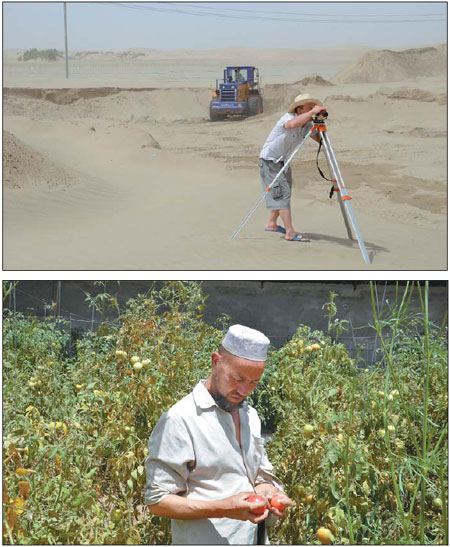
Top: A surveyor in Hotan county measuring a site for artificial greenbelt. Above: A farmer examines tomatoes in his greenhouse in Hotan. There are more than 100 greenhouses in the county. |
Experience has taught Chen of the forestry bureau that local people must be involved in, and benefit from, the program to prevent and control desertification. Without that crucial local input, the plants might easily die from a lack of attention.
"We have piloted a program of assigning care of plants and trees to local farmers. They put in the work of watering and taking care of them and when the plants are ripe, the locals can sell the produce. So they reap a financial benefit from the new oases, while Hotan benefits environmentally."
He said most of Hotan's seven counties have built new oases during the past couple of years.
Rich resources
About half an hour drive from the Hotan county seat, a new district is emerging from the desert. Thin drip-irrigation pipes run over manually flattened sand dunes for 28 km, and red willow, a common desert plant, and poplar trees have been planted to help stabilize the sand and provide a barrier behind which other plants can be sown.
"Although the desert looks lifeless, it has rich groundwater resources," said Wan Shiqing, director of Hotan county office for the prevention and control of desertification. "Once the water flows, there will be life."
In Hotan county, the average area of cultivation is roughly 866 sq m per person, which places a natural limit on the number of farmers the land can support and sometimes creates tensions and conflict among the residents. The new oasis is expected to provide a partial solution to the problem, said Wan.
"Total investment in the new district has reached 180 million yuan ($29 million) so far. This manmade oasis is expected to expand to around 400 sq km," Wan said.
Some of the dunes flattened to create the new 133-sq-km oasis were about 10 meters high, so it's hard to believe that the construction of the new oasis requires additional sand, transported from Beijing. The special sand that prevents water from filtering through the extremely fine-grain Taklimakan sands is used in the greenhouses of the new district.
Farmer Helili Tusonbak lost his land to the desert. As a result, he was eligible to rent one of the 100 greenhouses that have been erected in the area. He couldn't believe that tomatoes and watermelons can be grown in the desert.
"I thought it was a joke, but it actually happened," he smiled. Use of the greenhouses and amenities, including seeds, is free for the first year. Helili earned more than 10,000 yuan last year and is hoping to take on another greenhouse.
"When the plants on the new oasis are full grown, they will help to reduce the intensity of the sandstorms in Hotan county and Hotan city," said Wan. "I feel that the sky has become clearer since the new oases were built."
Memet Rozitohut's village stands next to an artificial oasis, created two years ago in Lop county. "There is less sand in the wind now, so it won't destroy as many flowers on my date trees as before," said the 47-year-old, who made 200,000 yuan last year.
"We used to see the desert as a threat, but now we see it as an opportunity," said Chen, the forestry bureau chief.
The jade-digging machines on the White Jade River now have a new role - flattering the sand dunes, but Chen warned that the artificial oases might create more desert if too much groundwater is consumed.
"It means we can't expand the oases as much as we would like, even if we have enough money. Everything must be carefully evaluated and planned," said Chen. "We have to respect nature."
Contact the writer at cuijia@chinadaily.com.cn
Tang Yue contributed to this story.