Never too old to learn new tricks
The huge number of retired Chinese enrolling at 'universities for the aged' is imposing immense pressure on the education system for the elderly, as Luo Wangshu reports from Chongqing.
 |
|
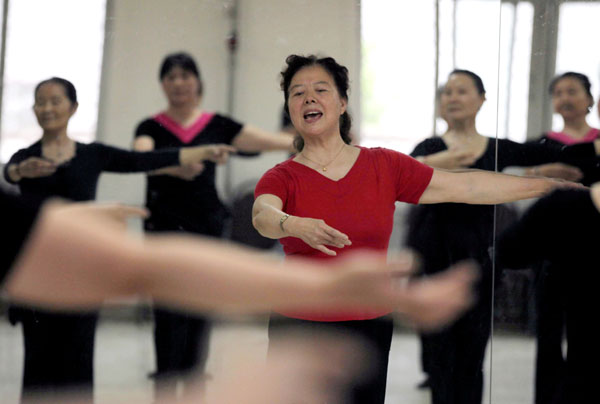
Li Guilan (center), 67, teaches senior students at a dancing class at the Chinese Academy of Sciences' College for the Elderly in Beijing. [Photo by Wang Jing / China Daily] |
Song Qing's was woken by her alarm clock at 3 am on a bitterly cold December morning in 2012. The recently retired 57-year-old cocooned herself in a thick down coat and traveled across Beijing to sign up for a calligraphy and painting class at Beijing Haidian University for Seniors, or BHUS. She arrived at the school at 4:15 am, ready for the start of enrollment at 7:30 am.
"I'd heard that in previous years, even students who arrived as early as 6 am failed to register for classes, so I decided to come earlier to guarantee a place," said Song.
During the spring semester, BHUS provides 12 classes, catering to 400 students. Although the classes were massively oversubscribed, Song was lucky enough to secure a place and has started her new "school life" in the calligraphy class.
Millions of retired Chinese people want to stay active by attending school, but only the lucky ones are able to win a place, because there are often far more applicants than places, even though figures from the China Association of Universities for the Aged show that 42,991 schools operated nationwide in 2012.
Shortage of places
"Today's retirees are better educated than previous generations and they pay more attention to the quality of their post-working lives," said Yuan Xinli, executive vice-director of the China Association of Universities for the Aged.
BHUS would like to expand the school and offer more places, according to Chu Shijun, the vice-president. However, the capital's largest university for retirees, with almost 2,600 students, has just nine classrooms.
"With the current facilities, our school is unable to recruit more students," said Chu, who admitted that the shoestring budget has resulted in a shortage of facilities.
Schools for retirees are run as charitable institutions. The average tuition fee is about 200 yuan per semester, and the colleges are mostly funded by governments at different levels.
In Beijing, each district provides financial support. BHUS received 1 million yuan ($163,000) from Haidian district in 2012. It also earned 700,000 yuan from tuition fees and 300,000 yuan through leasing classrooms at the weekends. The annual operating cost is about 1.9 million yuan, leaving a paltry 10,000 yuan profit, nowhere near enough to fund expansion plans.
In some places, such as Heilongjiang province and the municipalities of Tianjin and Chongqing, the provincial government fully subsidizes retiree schools. Meanwhile, those associated with large companies and organizations, such as the Chinese Academy of Sciences, also receive funding from their maternal organizations.
However, the low profit rate means nongovernmental and business investors are not interested in putting money into schools, so the financial burden falls on the government.
Zheng Min, vice-president of the Chinese Academy of Sciences' College for the Elderly, located on the campus of the Xi'an Institute of Optics and Precision Mechanics in Shaanxi province, said society pays great attention to adult education and invests in it heavily, but makes little effort to provide education for retirees.
Meanwhile, Yuan from the China Association of Universities for the Aged, outlined another reason for the imbalance in demand and supply: "Some elderly students attend school year after year and never leave. Because students don't leave and applicant numbers are always rising, the schools are oversubscribed. I know one woman in her 80s who has attended retiree school for more than 20 years."