Young parents' spending fuels children's economy
BEIJING - For China's new generation of moms and dads, most of whom remember childhoods filled with hunger and poverty in the 1970s and 80s, International Children's Day is an occasion for giving their kids the type of treats they never had.
Gao Hai, 6, has enjoyed a great week ahead of the festival, which falls on Saturday this year. He received expensive gifts, including a toy robot that can talk and move, was taken out to amusement parks and ate good food.
"I always feel pitiful when I think that my parents bought me nothing for the festival because they couldn't afford anything. So I want my son to have a sweet and memorable time," Gao's father says.
The heads of a typical family of three under China's one-child policy, Gao and his wife spend nearly half of their monthly income on their child. Apart from food and brand-name clothing, a large portion of the spending goes on preschool education and weekend tutorial classes such as music and English courses.
Like millions of young Chinese parents, the memory of their own meager early years and the prevailing idea of "don't let your child lose at the start line" have made the Gaos big contributors to the country's booming children's economy despite the rocketing costs of child-rearing.
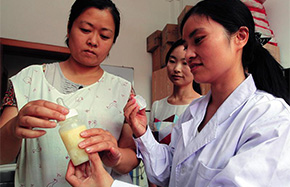
Chen Tingzhi is another parent making financial sacrifices for the sake of his offspring. Scared by contaminated milk powder and poisonous milk bottle scandals, he is careful in choosing childcare products. The 1980s-born father makes 2,000 yuan (324 US dollars) a month in south China's Hainan Province, but feeds his daughter with milk powder costing about 200 yuan per 900-gram can, spending which has required him to draft in financial support from his aging parents.
Statistics from US researchers Nielsen showed that sales of high-end milk formula with prices between 200 and 300 yuan per 900 grams increased 23.3 percent from a year earlier to hit 24.1 billion yuan in China last year.
One person feeling the benefit of such free spending by parents is Fu Mingliang, who has been a retailer at a toy street in Hainan for the past decade. He has been busying himself replenishing stock as the upcoming children's festival has bulled his business.
"There were only four toy stores close to mine. Now the whole street sells toys," says Fu. He says he doesn't worry much about the competition because local people, despite the relatively underdeveloped island economy, are willing to lavish money on their kids.
According to the China Chain Store & Franchise Association, Chinese parents poured 1.15 trillion yuan into the under-twelves market in 2012, and this figure is expected to expand at an annualized rate of 15 percent to top 2 trillion yuan by 2015.
"More anxious and crisis-aware than their fathers' generation, young Chinese parents are building for their children the kind of life they were deprived of themselves. Their endeavor to seek good childcare starts from the moment they decide to have babies," says Chen Wenxin, a professor at Hainan Normal University.
Because of the country's family planning policy, parents are liable to exhaust family resources to raise their only kid, and the bustling way of modern life has squeezed parent-child time, prompting working couples to rely on money to mend the relations, Chen adds.
Xue Shengwen, a researcher at the Shenzhen-based CIConsulting, a leading industry information provider in China, warns of the dual effects of the children's economy. The increasing attention on child-raising is good news for the industry, but a childhood overfed with material satisfactions will create money worship and vanity, the researcher believes.
"Recent years have seen a popular saying that kids are the most worthy assets in which to invest our money. But high input doesn't necessarily mean high returns. New-generation parents should be more rational about children's consumption," Xue says.