Tunnel builders sweat it out on new rail line
Testing conditions
At other construction sites, problems, such as complicated rock formations and unpredictable subterranean water leakage, have tested the construction team's patience and technical skill, said He Huaijiao, the program manager for the Pingzhai Tunnel and the Mayinghe Bridge in Pingbian Miao autonomous county.
 |
|
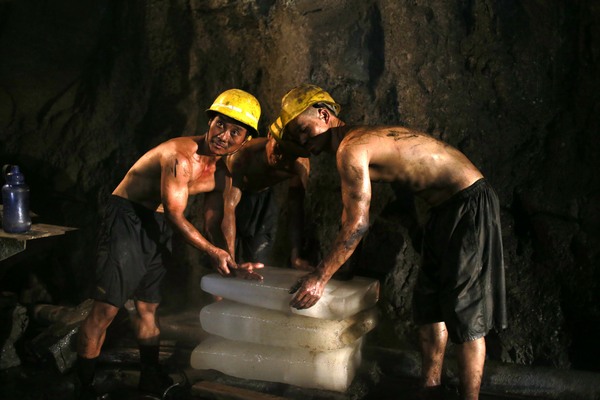
Workers use ice to lower the temperature in the Taiyangzhai tunnel. Photo by Feng Yongbin / China Daily |
Three years ago, the workers experienced their largest washout when approximately 3,000 cubic meters of water gouged a huge depression in the floor of the tunnel. "There was no way to fix it, so we made a concrete bridge that covered the hole and allowed workers and vehicles through," said He. "Even with three pumps running 24 hours a day, we were unable to drain the water completely."
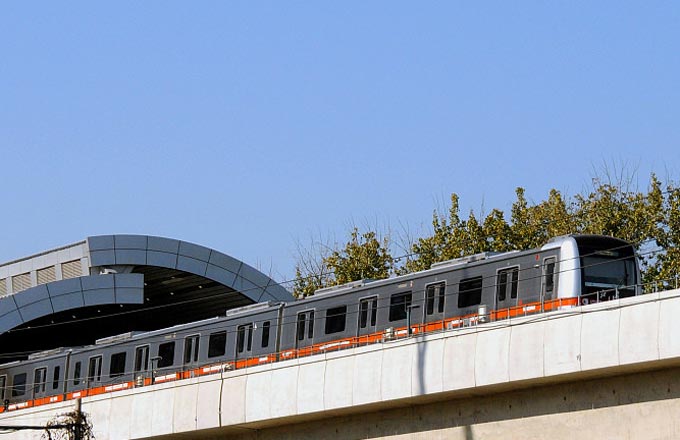
The Yuxi-Mengzi Railway became operational in April, trimming the journey time from Kunming to Mengzi to just four hours, and providing fast passage for goods between China and Vietnam.
At Mengzi North Railway Station, fertilizers and construction materials, Kunming and Yuxi's main exports to Vietnam, were loaded onto the trains. As an important part of the eastern line of the Pan-Asian Railway, the Mengzi-Hekou Railway will continue the role once played by the Yuxi-Mengzi Railway.
Yunnan's original railway network connected with the Yunnan-Vietnam Railway, built by the French government in the early 1900s. However, the 1-meter-wide track only allowed diesel locomotives to travel at a speed of 20 km per hour, meaning it took at least two days to carry cargo along the 468 km between Hekou and Kunming.
On the afternoon of June 24, two trains carrying fertilizer from Kunming arrived at Shanyao station, the transit point for Sino-Vietnamese trade, located 6 km from Hekou. One hour later, a Vietnamese locomotive pulling empty wagons arrived at the station. Once the customs procedures were completed, Vu Vu Quang, a Vietnamese border officer, took control of the trains for the Vietnamese stage of their journey. The wagons would be handed back on the next trip.
China's old diesel locomotives had 16 cars that could carry 30 tons of goods, only half the capacity of the trains that run on the new railway, which operates on the international standard gauge of 1.4 meters.