


Private museums increasingly under spotlight
To a casual observer, the collection at Jibaozhai Museum may have appeared to be a treasure trove. Its walls were lined with priceless relics from Chinese palaces and rare chinaware.
Yet novelist Ma Boyong smelled a rat. After visiting the museum, he used his blog to accuse the privately owned museum of exhibiting worthless forgeries.
 |
|
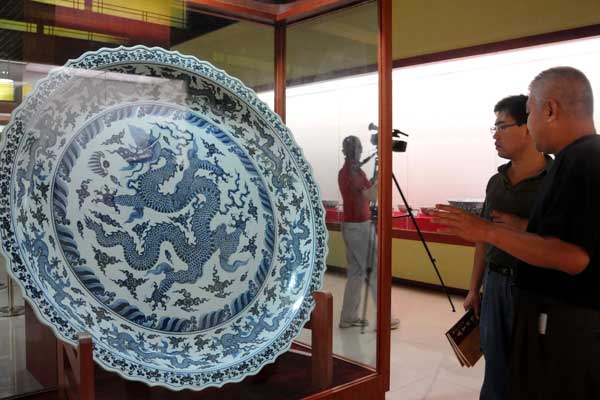
A chinaware is on exhibition at Jibaozhai Museum in Jizhou, Hebei province. The museum closed down last month because it "was not legally approved by the supervision department". [Wang Min / xinhua] |
For a start, he wrote on July 7, its animal head sculptures, similar to those looted in the 1800s from Yuanmingyuan, the Old Summer Palace in Beijing, are porcelain, not bronze.
"One set had breasts, and another set had tunics," wrote Ma, who has penned several books of historical fiction. He said it was hard to believe they were made in the Yuan Dynasty (1271-1368).
It was not long before the attraction, which opened in Hebei province's Jizhou in 2010, was one of the hottest topics online.
In response, Wei Yingjun, a consultant to the museum, insisted at least half of its 40,000 pieces were genuine relics, although experts had never appraised them due to a lack of funds.
Three days after Ma's blog post, the museum was closed down because it "was not legally approved by the supervision department", according to Li Baocai, director of museums for the Hebei Cultural Relics Bureau.
However, that swift action by authorities did not prevent netizens from questioning China's management of private museums, which experts say is lax and poses a major obstacle to the culture industry.
Free appraisals
Calls to Wei have gone unanswered since the closure. Previously, however, he said the museum was visited by 3,000 students a year and had been classed by the city as a Grade 3A scenic spot and "a patriotic education center".
So how did an illegal attraction with potentially hundreds of fake artifacts win such support?
"Private museums are allowed to have some replicas, but they should be clearly labeled so visitors aren't cheated, which is what has not happened at Jibaozhai Museum," Li explained, adding: "We can provide free appraisals of relics."
Yet he conceded that, in most cases, once a private museum is licensed they receive no supervision from the government.
"Collections at private museums are owned by individuals," he said. "It's not appropriate to check them frequently, as it's like going to someone's home and checking their belongings."
Yao Yuanli, who runs a private museum in Beijing, said the lack of management nationwide is hindering the development of a booming sector.
Jibaozhai Museum is not an isolated case, he said. "Many private museums have a large amount of forgeries, especially those that have not been approved legally."
Plus, he added, cultural projects can mean the allocation of precious commercial land and funding from the government.
Jibaozhai Museum started with an investment of 54 million yuan ($8.8 million), mainly from the Erpu village committee, which used what was left of the income generated by an iron factory it had run until 2006. The attraction also received an annual subsidy of about 600,000 yuan from Jizhou government.
It occupies four hectares, and since it opened surrounding land has been sold to property developers, bringing in millions for Erpu.
Ma Weidu, an antiques collector and curator at Guanfu Museum, which has branches in Hangzhou and Xiamen, recently told China Radio International the larger the museum, the more opportunities it has to get land from local governments.
High expenses
Many private museums with licenses also struggle to make ends meet.
"Almost none make a profit from ticket sales," Yao said. "They have to find other ways to support themselves."
He charges 40 yuan for admittance to his museum, which receives more than 10,000 visitors a year. "But it's still not enough to cover all our expenses, such as the electricity bills and salaries for the workers," he said.
Xisan Neihua Museum is one of 11 government-backed private museums in Shijiazhuang, capital of Hebei province. Among its exhibits are exquisite snuff bottles.
As it is free to enter, the attraction occasionally sells exhibits "so we have enough money to keep running", said a staff member who spoke on condition of anonymity.
Wang Xisan, who opened the museum in 2010, said his goal is not to make money but to focus on education and promote the culture of private museums.
Li Pengchu, a teacher at Shijiazhuang No 40 Middle School, said she has taken students to a number of museums, saying they like to experience different themes, and private museums are often good options.
"But I'm afraid there are more Jibaozhai out there, which will mislead students," she said. "The government needs to take measures to clean up the industry."
China has about 535 licensed private museums, accounting for 15 percent of all museums, according to the State Administration of Cultural Heritage.
The target is to increase the number to 20 percent of all museums by 2020.
The authority estimated there are roughly 1,000 illegally operated museums and said a new round of checks on private attractions is running through July and August.







Registration Number: 130349


