


Highs and lows of marine rescue
Responding to emergency calls can be both rewarding and traumatic, crews say
Most boats turn toward harbor in a storm to take refuge, but not the rescue vessel crewed by Pei Jiwen and his colleagues. Very often, it heads in the other direction, bracing against violent waves in the South China Sea.
"We set out in bad weather, which is when most accidents happen on the sea," said Pei, 43, chief engineer of the Dejin, a rescue vessel operated by the Nanhai Rescue Bureau. "Some call us marine firefighters. I think we're worthy of the title."
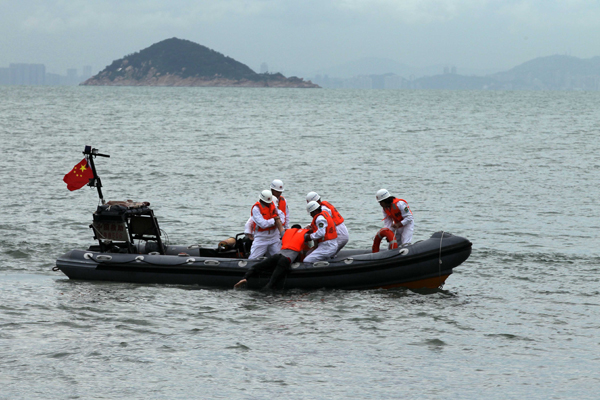 |
|
Members on the Nanhai Rescue Bureau conduct a drill in July. Photo by Wang Jing / China Daily |
Pei said he cannot remember how many rescue operations he has been a part of in the 20 years since he joined the bureau, which is in charge of maritime rescue operations on the South China Sea.
"Sea rescues are risky because of the unpredictable conditions," he said. "For us, the happiest moment is when we have saved someone from the brink of death."
In one operation in 2006, the bureau had boats searching 270,000 square kilometers of the South China Sea and rescued 500 Vietnamese fishermen during a typhoon. They also recovered 21 bodies.
Pei is one of China's 7,700 marine response workers, including those for sea rescue, salvage and air rescue.
In the past 10 years, they have saved 34,030 people, according to the Ministry of Transport.
Inland rescue
Marine rescue teams are also used for operations inland, said Qian Fugui from the Nanhai Rescue Bureau, in Guangdong province.
"Firefighting units often lack the equipment and experience to deal with incidents on rivers and lakes," he said. "So they contact us for help."
Quan said land-based rescue teams lack experienced divers. But he warned that even with skilled and well-equipped divers, missions on land can also be dangerous.
He recalled a mission in 2009 at a construction site in Shenzhen, a port city on the South China Sea. Three workers were trapped in a deep pit for the foundations of a high-rise. The pit, near a river, was flooded with about 10 meters of water after heavy rain.
"When we arrived, there was no sign of the workers. The pit was a large pool of yellow, murky water, with steel rods sticking out," said Qian, who supervised the rescue.
"We were told the workers were under the water, and they were probably not alive," he said. "The pit was full of construction materials, so just diving into the water to search for bodies was dangerous."
Emotional strain
Despite the risks, the divers descended in turn and searched the murky water inch by inch, at the request of the victims' families, and within several hours recovered all three bodies.
"Although we couldn't save them, retrieving the bodies was a comfort to their families," Qian said.
In addition to the physical risk, marine rescue teams face psychological challenges and can suffer trauma.
"Not everyone is saved," Pei said. "It's hardest when we see a person we've rescued die right in front of us."
He said missions can sometimes be delayed due to the irresistible force of nature and when rescue teams arrive it can be too late. For that reason, every vessel in service has an ice room to store recovered bodies.
"We recover the bodies so their families can see them one last time," Pei said.
Yang Weiwei, 27, with Nanhai No 1 Air Rescue Service, said he still feels nervous whenever he descends by rope from the helicopter during rescue missions, even though he has participated in dozens of operations in his five years in the service.
"The most unforgettable moments for me are when you find only bodies on board," he said. "Some fishermen have not heard of us and wouldn't think of calling us in an emergency. They only send out a mayday call when their situation becomes serious, and they may not be able to hold on until we arrive."
Hu Jingsui, who is married to a cook on a Nanhai Rescue Bureau vessel, said her husband often feels guilty for not rescuing more people.
"My husband is a man of few words, and he seldom talks about his work when we're together," she said. "Sometimes at night, he can't sleep, and he cries.
"He said he is scared, he is afraid to see someone take their last breath and die in his arms after being pulled from the sea."
?

















Registration Number: 130349


