Tourism's double-edged sword
 Comments
  Print
Print  Mail
Mail  Large Medium Small
But, the assumption that the "trickle-down" effect of money flowing from big investments to locals is "misguided", Hillman believes.
"The real challenge lies in creating opportunities for the poor within the new economic development."
Rose's Cafe stands out in Shangri-La's old town not only because of its famed hot chocolate, but also because it has one of the area's two Western-style sit-down toilets.
In her leopard-print dress, furry vest, boots, and long, shaggy black hair, the owner, who only goes by her English name, Rose, also stands out from the crowd.
Born in Liaoning province, she was living a life most Chinese parents would wish for their children - she was a university graduate and had a stable job with a multinational company in Guangzhou. Even so, she quit.
"I saved enough money from my job, so I traveled and eventually settled here," she says.
It is easy to see why Rose fell in love with the place. A feeling of inner peace resonates across the mountains when the sun goes down and people retire to their homes.
The only night-lights except on the main road are the blanket of stars generously sprinkled across the sky so close to the heavens.
The biggest danger from walking around at night is stepping into a pile of yak dung or running into one as they roam freely in the open fields, but Rose worries all this is changing now, as more and more tourists flood in.
"I used not to allow smoking in the cafe," she says, talking about indoor smoking, which is the norm in China. "But last year, I had to because many customers demanded it."
Domestic tourism has boomed in China as the middle class and their disposable incomes grow and they seek exotic locations for vacation.
While tourist spending has led to a welcome surge of income for many in Shangri-La, much of the Tibetan population is also feeling the negative effects of tourism.
"Some domestic tourists accuse me of cheating them," says 24-year-old Lobsang Yangzom, recounting some of her tour guide experiences. "At first I was offended and thought, why would I cheat you? I am Buddhist and we do not hurt others," she says, hand pressed to her chest as if physically hurt by the accusations.
"But then I learned that it is normal for some guides to cheat, so I am not upset. But here in Shangri-La, we are Buddhists and that is not our way."
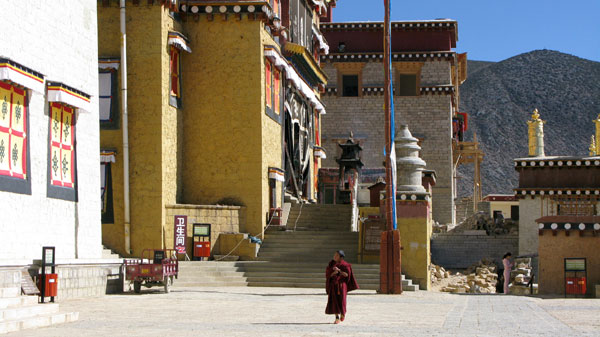
The town's Songzalin Monastery, known as "Little Potala" among tourists after the Potala Palace in Tibet autonomous region, is a major tourist attraction, but is first and foremost a place of Buddhist worship.
While the temple's entrance does have signs saying, "No Pictures, No Hats, No Sunglasses", in Chinese and English, Lobsang still has to remind visitors and ask them not to take photographs.
Australian scholar Ben Hillman writes that while tourists in temples provide some income through admission fees, monks' lifestyles are constantly being interrupted.
The environment has taken a hit as well. A study conducted in 2007 by the College of Business Administration and Tourism Management at Yunnan University concludes that the "ecological consumption" of a visitor from Shanghai for an "eight-day tour of Shangri-La" is more than that of a resident in six months.
Still, all is not lost for travelers wanting to experience Shangri-La for themselves, minus the cynicism and commercialism that tourism brings.
WildChina Office Director in China, Nellie Connolly, admits that while some authentic culture has been lost, there is still much to be positive about.
"We have noticed a big change since 2000, but something that we're really excited about is that there are still places in Yunnan that are less developed and less Disney-fied," she says, referring to the commercialization of Dali and Lijiang.
Winner of several travel awards, WildChina has been taking visitors to Yunnan since 2002.
"There are some negative aspects to tourism in China, but slowly but surely, this is also changing," Connolly says.
Using local guides and emphasizing responsible tourism to promote sustainable travel is improving, she points out.
"We're still really optimistic about Yunnan but we have to do it differently from how we did it five or 10 years ago."
Contact the writer at sundayed@chinadaily.com.cn.
|
|
Chinese-style carnival! Guides for Snake Year temple fairs in Beijing |

Related Stories
World's 3rd largest glacier in China's Tibet 2013-01-31 15:32
Tibet unveils national park at Heavenly Lake 2012-10-24 13:25
Climb, play and pray: Nedong County, Tibet 2012-09-29 14:26
Shangri-La Hotel , Harbin opens wintry restaurant and bar 2013-01-24 12:35
Shangri-La Hotel opens ice palace 2013-01-23 16:15



Copyright 1995 - 2010 . All rights reserved. The content (including but not limited to text, photo, multimedia information, etc) published in this site belongs to China Daily Information Co (CDIC). Without written authorization from CDIC, such content shall not be republished or used in any form. Note: Browsers with 1024*768 or higher resolution are suggested for this site.
License for publishing multimedia online 0108263 Registration Number: 20100000002731 