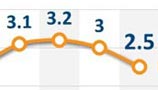
BEIJING - China's latest macro data, especially the disappointing manufacturing activity index, made people worried over the trend of softening growth momentum and a shaky start of the Chinese economy in 2014.
Analysts, however, said the market needed to treat China's monthly macro data in January and February with caution since they are traditionally distorted by the effect of the Chinese New Year, which is difficult to remove statistically due to the short sample periods and ?floating dates.
The manufacturing activity index, or called purchasing managers' index (PMI), is so far the first and important indicator to measure China's factory activities and the country's manufacturing-based economy at the start of 2014.
Both the official and HSBC's PMI for January posted notable declines from the previous month.
The official PMI, released on Saturday by the National Bureau of Statistics (NBS) and the China Federation of Logistics and Purchasing (CFLP), dropped to a six-month low of 50.5 percent in January, from 51.0 in December.
January continued December's decline and indicated the lowest factory activity since August, mainly due to weak output and new orders, NBS and CFLP said in a joint statement.
But the NBS and CFLP reminded of the fact that the reading marked the 16th consecutive month of expansion above 50, which is the expansion/contraction watershed.
The output sub-index fell to 53.0 in January from 53.9 in December, the second consecutive decline after reaching a high of 54.5 in November.
The new orders sub-index fell for a fourth consecutive month, by 1.1 percentage points to 50.9. New export orders fell by 0.5 percentage points to 49.3 -- a sub-50 reading for two consecutive months -- implying weakening overseas demand.
"The factors dragging down the index in January were mainly the slower momentum of output and new orders expansion, consistent with what was indicated by the HSBC PMI," said Zhang Zhiwei, chief China economist with Japan's Nomura Securities, in a research note.
A HSBC/Markit survey, released on Thursday, showed the final reading of China's manufacturing PMI for January contracted for the first time in six months.
HSBC China's PMI in January dipped to 49.5 from 50.5 in December, the first deterioration of operating conditions in the country's manufacturing sector since July.
The deterioration of the headline PMI largely reflected weaker expansion of both output and new business in January. Firms also cut their staffing levels at the quickest rate since March 2009, according to the HSBC/Markit survey.
Growth concerns about China are on the rise, but the market may overreact to weak data in January, said Lu Ting and Zhi Xiaojia, China economists with Bank of America Merrill Lynch, in a research note.
China's monthly year-over-year macro data in January/February are significantly distorted by the different timing of the Lunar New Year. This time is no different, as the Chinese New Year started from January 31 but was from February 10 last year, they said.
Business and industrial activities may have slowed down and small enterprises could send migrant workers home weeks ahead of the holiday, resulting in much quieter activities in January compared to December 2013 and January 2013.
It means both year-on-year and month-to-month activity measurements this January could look particularly poor without proper seasonal adjustment. That is why the NBS only publishes major activity indicators such as industrial production and fixed asset investment for January and February combined, Lu and Zhi said.
"We do not think a notable growth slowdown is evident at present. But we caution about a possible deterioration in market sentiment relating to China's growth outlook.
"We maintain our 2014 growth forecast at 7.6 percent and reiterate our view that the government will maintain a neutral monetary policy and execute a slightly more proactive fiscal policy in 2014," they said.
Zhang, of Nomura, was relatively pessimistic.
Since the official PMI was launched in 2005, the indicator has declined 0.2 percentage points on average in January, suggesting that the relatively large drop in January of 2014 was "more than just a seasonal effect," he said.
"We believe the negative impact of tighter liquidity conditions and higher risk premiums in the trust sector is showing on the real economy," Zhang said.
He expected the official PMI to decline further as the gap between new orders and finished goods inventory narrows.
But Zhang warned that people needed to wait for further signals from both the official PMI and other headline activity indicators, such as industrial production and electricity generation, over the next few months before making a decision.

Copyright 1995 - . All rights reserved. The content (including but not limited to text, photo, multimedia information, etc) published in this site belongs to China Daily Information Co (CDIC). Without written authorization from CDIC, such content shall not be republished or used in any form. Note: Browsers with 1024*768 or higher resolution are suggested for this site.
License for publishing multimedia online 0108263 Registration Number: 20100000002731