Move aimed at 'reminding people to never forget the past and cherish peace'
Two national memorial days are to be marked, according to draft resolutions being reviewed by the top legislature.
|
 |
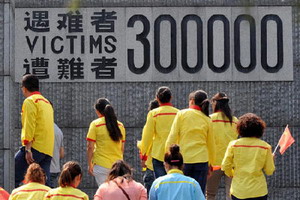
Japanese troops occupied the then-Chinese capital of Nanjing on Dec 13, 1937, killing more than 300,000 Chinese civilians and unarmed soldiers in the following weeks.
Japan surrendered on Sept 2, 1945.
Members of the National People's Congress Standing Committee are scheduled to review the two drafts during a session being held from Tuesday to Thursday.
"Chinese people contributed greatly to the world anti-fascist war, which should be respected through a national memorial day," one of the drafts states.
The condolence day on Dec 13 will commemorate victims of the Nanjing Massacre and also all Chinese killed by Japanese invaders.
"The two memorial days are aimed at reminding people to never forget the past and to cherish peace," said Li Shishi, director of the Legislative Affairs Commission of the NPC Standing Committee, explaining the drafts to lawmakers on Tuesday.
He said the move will also inspire Chinese people to realize "the dream of great national rejuvenation".
Some political advisers and lawmakers first called for a memorial day for the Nanjing Massacre 10 years ago.
In March 2005, Zhao Long, a national political adviser, submitted the first proposal in this regard. Zhao was followed on March 10, 2012, by Zou Jianping, a deputy to the National People's Congress and also president of the Nanjing Art Institute, who tendered a similar proposal.
The Jiangsu provincial government has held memorial ceremonies for victims of the Nanjing Massacre on Dec 13 every year since 1994.
Li Yongnian, a 58-year-old Nanjing resident, was glad to hear about the two memorial days.
"Setting the memorial days is not aimed at spreading hatred, but at letting the people understand how difficult it was to achieve peace," he said.
Zhu Chengshan, curator of the Nanjing Massacre Memorial Hall, said it is planning more exhibits this year to help visitors learn about history.
The hall has been listed as a China cultural heritage site and is preparing to apply for a world heritage listing with the United Nations Educational, Scientific and Cultural Organization, he said.
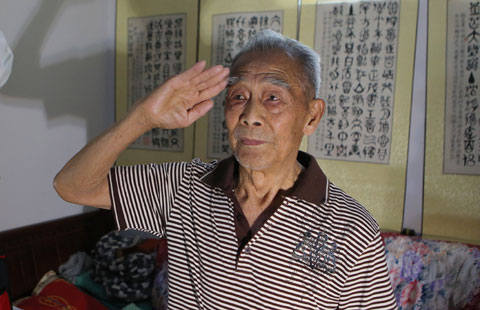
She Ziqing, 81, a Nanjing Massacre survivor, said he felt relieved when he heard about the two memorial days. His mother was killed by Japanese soldiers during the massacre.
"Those who died can now rest in peace," he said.
Zhou Yongsheng, a professor of Japanese studies at China Foreign Affairs University, said setting a national memorial day for massacre victims will send a message to Japanese right-wing politicians that their attempts to challenge the post-war international order and to whitewash Japan's wartime atrocities will be futile.
Qu Xing, president of the China Institute of International Studies, said the Sino-Japanese relationship is based on Japan's clear understanding of history and self-reflection.
"If Tokyo chooses to deny history, it brings no benefit to the deteriorating relationship," he said.
Hiroshi Tanaka, professor emeritus at Hitotsubashi University in Tokyo, said Chinese and Japanese people have different views of World War II, adding, "They are far apart."
He said he plans to bring Chinese war survivors, including those who survived the Nanjing Massacre, and Japanese people together.
"The Chinese could then tell the Japanese what really happened in Nanjing in December 1937," said Tanaka, co-organizer of several Japanese non-governmental organizations committed to letting Japanese know the truth about their country's wartime history.
"Direct contact between the Chinese and Japanese is very important," he said.
Contact the writers at anbaijie@chinadaily.com.cn caihong@chinadaily.com.cn and cangwei@chinadaily.com.cn
Mo Jingxi contributed to this story.
 |
 |
| The War of Resistance against Japanese Aggression | Remembering the Nanjing Massacre |


Copyright 1995 - . All rights reserved. The content (including but not limited to text, photo, multimedia information, etc) published in this site belongs to China Daily Information Co (CDIC). Without written authorization from CDIC, such content shall not be republished or used in any form. Note: Browsers with 1024*768 or higher resolution are suggested for this site.
License for publishing multimedia online 0108263 Registration Number: 130349