Walking on his tiptoes, Ping'an strolls through Beijing's Forbidden City, his suspecting eyes glowing in the dark of the palace that once housed emperors and their concubines.
For years, the cat has roamed the empty lanes of the former royal palace every night after it closes its doors to visitors, in search of his archenemies: mice.
 |
|
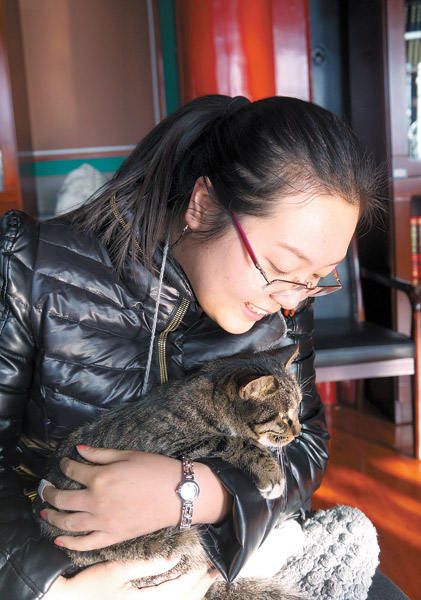
A staff member at the Forbidden City holds a stray cat, one of around 200 living at the site. Staff members say some of the cats may be descendants of royal pets, while most are strays from the surrounding streets who have been given a home. Provided to China Daily? |
Before being taken in by Shan Jixiang, curator of the Forbidden City — also called the Palace Museum — the animal lived a brutish life beyond the museum's walls, howling and foraging for food among the dustbins during the night.
According to Ma Guoqing, director of the sanitation department at the Palace Museum, some 200 cats, including Ping'an — whose name can be literally translated as "safety" — have in recent years found a home at the historic site.
"Some of them may even be the descendants of royal pets of the past, while the rest are stray cats taken in by the museum staff," said Ma.
Cats have long lived in the Forbidden City, which dates back more than 600 years. They were kept as royal pets for the emperor and his relatives.
Now the little creatures have outlived their masters.
Though there are no current records on the number of stray cats in Beijing, a report from the Capital Animal Welfare Association in 2010 put the number at around 200,000.
According to the report, one female cat can have as many as three or four litters a year, ultimately adding another 100 cats to the stray population in its lifetime.
Stray cats have always been a headache for China's city authorities, who often receive complaints from residents about the animals' unpleasant smell and howling at night.
For the archaeological conservators of the Forbidden City, the rapid surge in the number of cats has also brought a challenge — how to treat the kitties humanely while maintaining a clean environment.
Ma Guoqing said the museum started to realize the seriousness of the problem in 2009, when stray cats in large numbers were often seen skulking through the yard and walking the walls.
"The presence of cats could pose a threat to visitors, and their excrement is definitely an eyesore," said Ma.
A special program began in 2009 to take care of the cats.
The program follows the trap-neuter-return principle, or TNR, a method of humanely trapping stray cats, spaying or neutering them and then returning them to the location where they were collected, said Gao Haiying, a Beijing-based animal protection organization staff member in charge of the museum's program.
Gao said China does not have a tradition of neutering pets, as the owners think making the animals infertile will harm their health. But this way of thinking has led to rising numbers of stray animals.
In a densely populated city like Beijing, the control of stray cat populations has become a controversial issue, with people divided on the two main options: sterilization and euthanasia.
Ma said 181 cats in the Forbidden City have been neutered in the past five years and the number of strays is now stable, adding that every neutered cat has been marked to tell it apart from the others.
Ma even has a ledger in which he has recorded each cat's "personal information": name, pregnancy status, neutering operation type and the amount of money spent on the operation.
From 2009 to 2013, the program cost 18,410 yuan ($3,020), a small amount compared with the whole sanitation work budget, said Ma.
The museum's money has not been spent for naught. Though rarely seen by the visitors, the cats have played an important role in protecting the precious antiques.
"They are a powerful deterrent against museum rats, and we have not had a single cultural relic damaged by cat claws," said Ma.


Copyright 1995 - . All rights reserved. The content (including but not limited to text, photo, multimedia information, etc) published in this site belongs to China Daily Information Co (CDIC). Without written authorization from CDIC, such content shall not be republished or used in any form. Note: Browsers with 1024*768 or higher resolution are suggested for this site.
License for publishing multimedia online 0108263 Registration Number: 130349