|
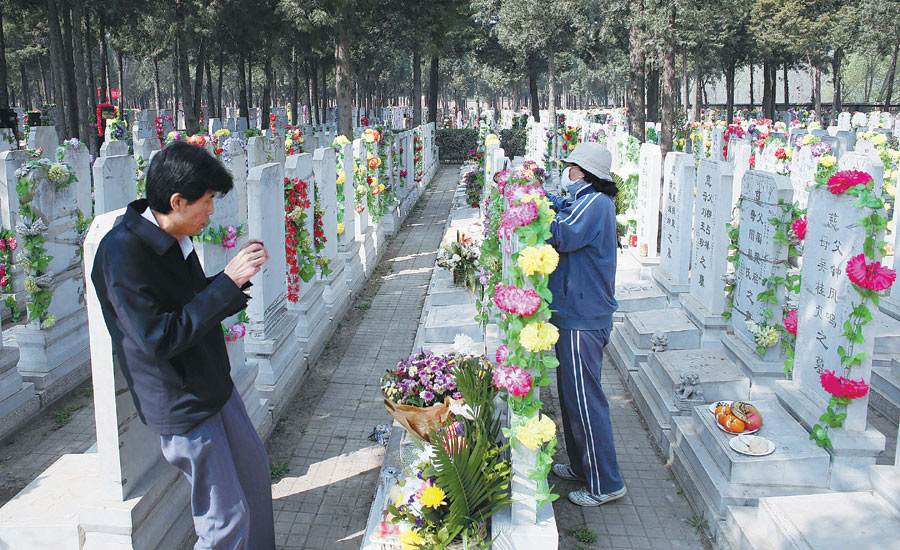 A man visits the grave of a family member at Beijing Expatriates Cemetery, which used to host many foreigners who died in China and now serves mostly Chinese. Wang Jing / China Daily |
While expats are coming to China in ever-greater numbers for work, only a few plan and are able to spend eternity here
Fallen leaves return to their roots, according to an old Chinese saying, referring to most people's wish to be buried in their place of origin.
Regardless of how far one may have wandered, it's much easier to achieve that wish these days than, say, a century ago because of the vast improvements in transportation and logistics.
Years ago, China had cemeteries that were exclusively for foreigners, mainly in cities that had foreign concessions, areas ceded by China and administered by foreign powers.
But that's history. In recent years, China has restricted the burial of foreigners. Simultaneously, cremation has become the more common option, and international shipping of bodies has become more practical.
Cemeteries that were formerly for foreigners only are now open to Chinese people who wish to find eternal rest in an international community.
Beijing Expatriates Cemetery, formerly the capital's largest cemetery for expatriates alone, has interred nearly 5,000 Chinese since 1996.
Shanghai Wanguo Cemetery, which holds the graves of more than 600 foreigners, is now part of the Soong Ching-Ling Mausoleum Park, where Soong Ching-ling, whose husband Dr Sun Yat-sen was the founding father of the first republic of China, lies buried together with other notable Chinese.
"It is nearly impossible for a foreigner who has no relative in China to have a body buried here now," said Wilfried Verbruggen, who operates a body repatriation service in Beijing.
In 2008, the Ministry of Civil Affairs released a regulation on the management of foreigners' funerals and interment that largely banned their being buried in China.
But there are exceptions.
Xiao Chenglong, deputy director of a center that studies funeral development and interment, said, "It looks like more foreigners want to be buried in China.
"Some of them may have strong emotional ties to the country or make a great contribution to China. We should give them access if that is what they hope for," said Xiao, of the 101 Research Institute under the Ministry of Civil Affairs.
Shanghai Wanguo Cemetery accepts applications for the burial of foreigners, but the criteria are high, said Li Chuntao, director of cultural relics preservation of the Soong Ching-Ling Mausoleum's administration.
"The people buried here have to have made exceptional contributions to society. The applications must be approved by the municipal government," he said.
As cremation becomes more the norm and logistics improve, foreigners increasingly choose to have their ashes or bodies shipped home.
The National Funeral Association has set up a nationwide network for international body repatriation and transports about 1,800 remains a year.
According to the Ministry of Civil Affairs, the number is six times the average of the early 1990s.
Verbruggen, who has been involved with body repatriation for nearly eight years, said his business increases by 15 to 20 percent annually. On a personal note, he said he would like to return home after death.
"My wish is that my body will be buried in Belgium, my native country; very simple, and I hope my family and friends will make it into a party! It's no big deal, no need for grief. We are born to die," he said.
The cemeteries for foreigners that have survived over the past century serve as witnesses to China's transformation, testimony to history and a bond of international friendship.
After China signed a treaty with Great Britain in 1842, the ports of five cities, including Shanghai and Fuzhou, were opened to Western merchants. Foreigners moved there with their families. When some countries were granted concessions, they built cemeteries in them for foreigners.
In Shanghai, Huaihai Park and Jing'an Park used to be cemeteries in the International Settlement, and more than 4,300 people were buried, 93 percent of them foreigners.
Beijing had cemeteries for the French, British, Russians, Japanese and Portuguese in 1929, as well as an international cemetery.
A number of famous foreigners - such as Shafick George Hatem (1910-88), a doctor from the United States who became a Chinese citizen - are buried in Babaoshan Revolutionary Cemetery.
Edgar Snow (1905-72), a US journalist and the author of Red Star over China, is buried on the campus of Peking University.
The capital also held tombs of missionaries, such as Matteo Ricci (1552-1610) and Johann Adam Schall von Bell (1592-1666). But most of these have been removed in the waves of urban development over the past decades.
To clear cemeteries and tombs from the city center for municipal development, the Beijing government established an expats' cemetery in the northeast outskirts of the city in 1952. It is now known as Beijing Expatriate Cemetery, funeral and burial expert Zhou Ji-ping wrote in his book History of Beijing Funeral and Interment.
Foreigners' remains were moved from old gravesites to the new cemetery or returned to their native countries.
At one time, about 1,400 foreigners lay buried at Beijing Expatriate Cemetery, but now there are only about 30 most of the other graves were damaged during the "cultural revolution" (1966-76).
Shanghai Wanguo Cemetery, on Hongqiao Road in Changning district, holds the graves of more than 600 foreigners from 26 Western and Asian countries.
 |
 |
 |
|
|
|
|
|
|
|
|
Copyright 1995 - . All rights reserved. The content (including but not limited to text, photo, multimedia information, etc) published in this site belongs to China Daily Information Co (CDIC). Without written authorization from CDIC, such content shall not be republished or used in any form. Note: Browsers with 1024*768 or higher resolution are suggested for this site.
License for publishing multimedia online 0108263 Registration Number: 20100000002731