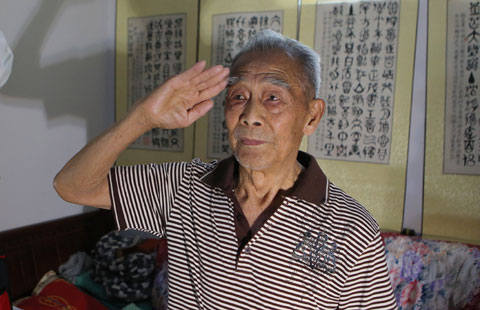
Chinese honor their dead on Tomb Sweeping Day, which fell on April 5 this year, but Qian Tongsheng also remembers his lost family members on March 25, when organ donors are remembered in China.
On those two days every year, the 73-year-old from Wuhan, Hubei province, and his family head to Shimenfeng Memorial Park, where the names of donors are inscribed.
Qian is quick to locate the name of his mother-in-law, Wang Kezhen.
Wang, who died in 2004, became the city's fourth donor after Wuhan started to receive organ donations in 2000. To date, more than 800 people in the city have donated their bodies or organs to people in need, or for medical research.
The increase in the list of registered donors has been swift, said Luo Gangqiang, a member of Wuhan Red Cross, rising from only one donor in 2000 to 183 in 2012.
The Shimengfeng Memorial Park, opened by the Wuhan Red Cross on March 26, 2005, and the first of its kind in the country, is fast running out of space for names.
"The monument only has space for 800 names," said Luo, adding that the city government plans to expand the park into the country's largest memorial square for organ donors. Two memorial walls will be built on the 3,000-square-meter site, enough to hold more than 6,000 donors' names.
Qian, who first learned of organ donation in the late 1990s, has become an active advocate of the practice.
Qian decided to be a donor in 2000 when his former teacher died. "I realized that people died and were then buried. I'd like to have another option, perhaps a more meaningful one," he said.
He also convinced members of his family to register as donors. His mother, mother-in-law and wife all joined him in registering. In 2004, his mother-in-law died and her body was transferred to Tongji Medical College for medical research.
Wuhan Red Cross built the park to thank donors and maintain the Chinese tradition of remembering the dead on Tomb Sweeping Day, also known as Qingming.
"The donor is still a loved one, leaving behind family and friends. The past is past, but memories stay in the minds of the living," Luo said.
"Every year as Qingming approaches, these emotions grow even stronger. To express our gratitude for those selfless actions, we built this place as a way for the families to come to terms with their grief."
Despite a rapid increase in social awareness and greater acceptance of organ donations, Luo said, the procedure for becoming a donor can be complicated in China. Even if the deceased person signed a contract to be a donor, the process is not guaranteed to run smoothly.
"We still have to get agreement from the family, and that can be very hard. Even when someone signs the paperwork individually, we also need a family member to sign as a custodian," Luo said.
Qian said his family is tolerant and open to the concept of organ and body donation. They accepted the procedures done on Wang's body calmly.
But some of his relatives and friends hold a conservative attitude toward body and organ donations.
Chinese people are traditionally resistant to donating their bodies and organs, and Qian said he often has to explain why such donations are meaningful.
In July 2012, he cycled from Wuhan to Lhasa, the capital of the Tibet autonomous region, via the Sichuan-Tibet Highway with a 68-year-old friend. Qian tied Red Cross flags to the back of his bike and tried to raise awareness of donations during his 20-day trip.
"After introducing myself, I would tell them that the policy was not the same in every region and they needed to ask their local Red Cross for more detailed information," he said.
Luo from Wuhan Red Cross said organ donations are usually for three purposes.
The first includes requests for specific organs such as liver or kidneys, as well as skin and corneas to save lives or for those in need. The second is for medical teaching and the third is for research on specific illnesses, genes or diseases.
"The need for body donations in all three aspects is acute. For research on the longevity of genes, body samples of those aged 80 and over are extremely rare," he said.
Because of the shortage of organs, China has the largest number of patients worldwide waiting for transplants. Every year, 300,000 people wait for organ transplants but only 10,000 are successful. Seventy to 80 percent of potential donations do not occur because family members do not approve.
Yang Wanli in Beijing
contributed to this story.
liukun@chinadaily.com.cn


Copyright 1995 - . All rights reserved. The content (including but not limited to text, photo, multimedia information, etc) published in this site belongs to China Daily Information Co (CDIC). Without written authorization from CDIC, such content shall not be republished or used in any form. Note: Browsers with 1024*768 or higher resolution are suggested for this site.
License for publishing multimedia online 0108263 Registration Number: 130349