|
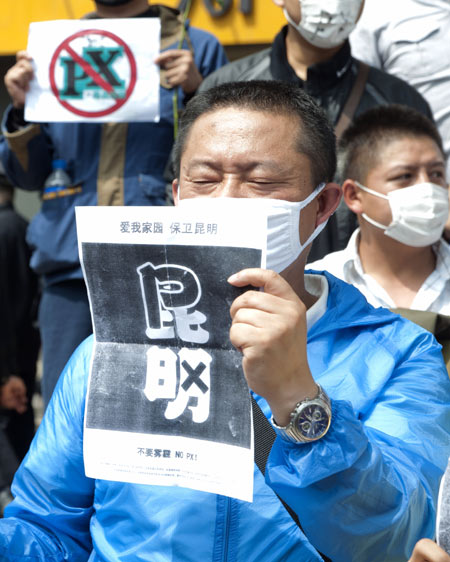 A man participates in a protest in Kunming, capital of Yunnan province, opposing construction of a chemical plant in May 2013. Provided to China Daily |
Most-common incidents caused by labor disputes, land acquisitions
Public protests since 2000 were usually sparked by labor disputes, land acquisitions, forced demolitions, pollution, traffic accidents and incidents involving ethnic groups, a major report found.
However, one researcher raised concerns that the report did not reflect the "true situation" in China because it was based solely on mainstream media coverage.
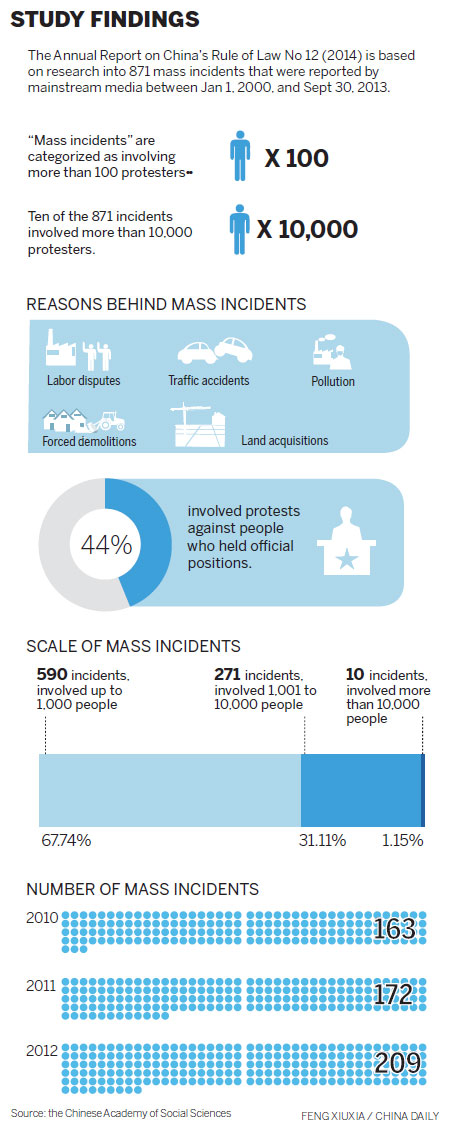
Forty-four percent of public protests involved people venting their opposition to officials' actions, according to the report by the Chinese Academy of Social Sciences.
"Mass incidents" are defined incidents involving more than 100 protesters - some have involved more than 10,000.
|
 |
"The research includes only incidents reported by the mainstream media and may not show the whole situation," said Shan Guangnai, from the Chinese Academy of Social Sciences.
Shan said the government needs to change its development model, which he said gives too much attention to GDP but little to the environment, which is increasingly becoming a political issue as more of the public questions the effectiveness of anti-pollution measures.
"Officials should also change their approach to work," Shan said. "In land acquisitions and forced demolitions, for example, many officials often overlook public interest."
The report recorded that 590 of the 871 protests involved up to 1,000 people, accounting for 67.7 percent of the incidents.
Incidents involving 1,001 to 10,000 people, 271 in all, accounted for 31.1 percent of the total. Just 10 incidents, or 1.1 percent, involved more than 10,000 people. Among the 10 mass incidents, five were sparked by pollution issues, the report said.
The report also found that 36 of the mass incidents resulted in fatalities, with 79 people killed.
The protests were divided into four categories: spontaneous, such as those following a traffic accident or a housing dispute involving tenants and landlords; targeting schools, enterprises and grassroots autonomous organizations such as village committees; targeting the government or officials; and other incidents, such as those involving ethnic groups.
The largest category of incidents, 387, involved protests against social organizations such as enterprises. Running a close second, 383, were incidents of protests against the government or officials.
Of those 383 incidents, 45.4 percent were sparked by improper law enforcement. Protests against land acquisitions and forced demolitions accounted for 21.7 percent, and protests involving petitions and the protection of rights accounted for 13.6 percent.
The report identified the police and chengguan - urban patrol officers - as the government agencies most often involved in improper law enforcement leading to mass incidents.
There has been a trend of increasing mass incidents, the report found.
The report identified 2010, 2011 and 2012 as leading years for mass incidents, with the number rising each year. The number of incidents involving more than 100 people came to 163 in 2010. The number increased to 172 in 2011 and 209 in 2012.
The report highlighted that mass incidents were more common in developed areas. Guangdong province accounted for 30.7 percent of the total. The report also found 319 of the 871 incidents occurred in South China, while 189 happened in East China.
Labor disputes led to 267 mass incidents, the report found.
Lyu Yanbin, an associate professor at the academy and one of the main editors of the report, said the rising trend was due to many factors and did not necessarily mean that the government or officials were always to blame for such incidents.
"Some people also pursued unjustifiable benefits from the government," Lyu said.
Yu Jianrong, head of the Rural Policy Study Center at the academy, said that rapid economic development triggered more demand for land, resulting in disputes over acquisitions and forced demolitions.
Guangdong initiated reforms early, and many policies were developed and implemented in a haphazard way, Yu said.
Transparency urged
Of the 871 cases presented in the report, 81.6 percent were organized incidents.
The vast majority of incidents were resolved by successful government intervention, but 12 percent reoccurred.
This shows the government should improve its ability to intervene successfully and find solutions to sources of dispute, the report said.
The public's participation in government decision-making processes is unsatisfactory, and channels for resolving disputes and lodging appeals are less than adequate, the report said.
The report recommended that the government make its handling of mass incidents more transparent.
houliqiang@chinadaily.com.cn
Related:
44 investigated after Maoming petrochemical plant protest
China detains 18 in chemical plant protest


Copyright 1995 - . All rights reserved. The content (including but not limited to text, photo, multimedia information, etc) published in this site belongs to China Daily Information Co (CDIC). Without written authorization from CDIC, such content shall not be republished or used in any form. Note: Browsers with 1024*768 or higher resolution are suggested for this site.
License for publishing multimedia online 0108263 Registration Number: 130349