 |
|
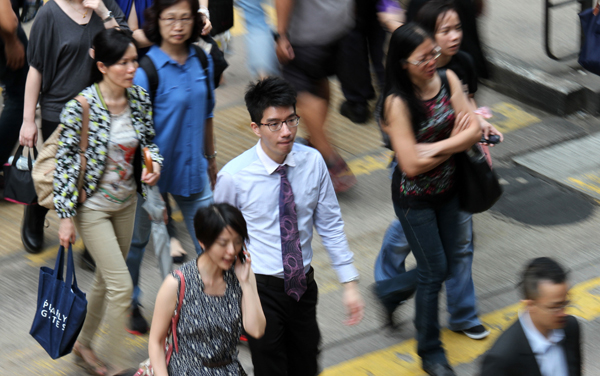
White collar workers in Hong Kong may feel their options are cramped. Residents of large Asian cities spend more time at work than just about anyone else globally. Photos by Parker Zheng / China Daily |
The death of Pradnya Paramita in Jakarta last December kicked off a debate about work hours in Asia. The 27-year-old copywriter collapsed and died after allegedly working for 30 consecutive hours.
In a report last August, job-listing website eFinancialCareers found more than two-thirds of 1,738 of Singapore's finance and banking professionals surveyed worked weekends, and about 43 percent remained contactable for work day and night.
In the 2014 Human Capital Survey released by accounting body CPA Australia, staff members in Hong Kong said they endured long work days and this was a key reason for changing jobs.
In reaching out to 350 accounting professionals at multinational corporations, accounting firms, listed and private companies and non-profit organizations for the survey, CPA Australia found 45 percent of respondents hoped to change jobs in the next six months, and a third said they were looking for a better work-life balance. Salaries and career development came second and third.
This may have a direct bearing on Hong Kong's economic prospects, analysts said.
"Hong Kong's competitiveness and productiveness are two different things," said Peter Lee, managing director at Veco Invest (Asia) and former divisional president at CPA Australia.
"If employees have a better work-life balance, their (productivity) will improve, thereby maintaining Hong Kong's competitiveness."
The issue extends to most countries in the region, to varying degrees.
Workers in the largest Asian cities spend more time at work than just about anyone else globally. However, this may actually be costing companies money and pushing workers away from some of the world's fastest-growing economies.
According to the International Labour Organization, most countries in Asia have a 48-hour working week, but almost a third of the countries in the region do not have a regulated maximum of hours of work. Another third put the weekly limit at 60.
Japan introduced standard working hours of eight hours per day and 40 hours per week, as early as 1994.
South Korea also introduced a 40-hour workweek in 2003, but that has rarely been followed. Also, the law did not count weekends, which meant employees could put in more hours during those two days and on holidays.
Last September, South Korea cut the maximum number of hours that can be worked per week to 52, down from 68.
In Singapore, the working hours should not exceed eight per day or 44 per week.


Copyright 1995 - . All rights reserved. The content (including but not limited to text, photo, multimedia information, etc) published in this site belongs to China Daily Information Co (CDIC). Without written authorization from CDIC, such content shall not be republished or used in any form. Note: Browsers with 1024*768 or higher resolution are suggested for this site.
License for publishing multimedia online 0108263 Registration Number: 130349