|
|
Young monks at Tashilhunpo Monastery in Xigaze prefecture of Tibet autonomous region. [Photo by Song Wei/chinadaily.com.cn] |
 |
| Visual impressions of Tibet |
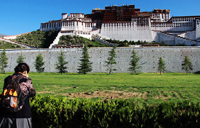 |
| Impressions of Tibet |
But scholars and journalists from China and abroad attending the ongoing forum on the development of Tibet said that Westerners' "Shangri-la complex" is hampering and limiting rational understanding of the autonomous region of China.
In many Chinese eyes, Tibet used to be a backcountry with an inhumane serf system. The highland craves for development and civilization as any other part of the world.
Hilton had never been to the Tibetan areas he wrote. When journalists, film directors and politicians in his time portrayed Tibet as a heavenly place, the region was under the feudal system -- a form of society the same cruel as, if not worse than, its European alternatives in the dark Middle Ages.
It was also a land where the average life expectancy for Tibetans was no older than 36 years and wives with extramarital affairs would have their noses and ears cut off for punishment.
"Despite the British invasion of Tibet in 1904, the West did not have the opportunity to understand Tibet," Alessandra Spalletta, China news editor of the Italian news agency AGI, spoke at the forum. "They started a mystification of Tibet while building the mythology of 'Shangri-la.'"
"Western people are fond of their own images of Tibet," she said, "rather than the real Tibet."
As some scholars pointed out, Tibet has become a "spiritual supermarket" for Westerners, who are trying to find what they have lost in their own societies in the process of industrialization and modernization.
Some believed that Tibet, as the "last pure land on the earth," should be immune from any development which they are afraid might lead to destruction of the traditional Tibetan culture and annihilation of Tibetan Buddhism.
"Those people believe that Tibet should remain in a primitive stage for ever and Tibetans should always ride yaks and live in tents," Cui Yuying, vice head of the State Council Information Office, spoke at the opening ceremony of the forum.
For the past half century, however, Tibet has been on an irreversible path of development and civilization, which complies with the general trend of the development of the human society, the senior official said.
With the "Shangri-la complex," many Western scholars have opted to study Tibet's history before the 20th century. Some even suggest the history of Tibet after 1951, when the region was peacefully liberated, is not worth studying at all. Some Western media have shunned the economic achievements Tibet has made over the recent decades.
The notion of Shangri-la, created by the Westerners, has been utilized by separatists for splitting Tibet from China.
"Romanticization (of Tibet) is a part of the Dalai Lama's campaign for separatism," said Narasimhan Ram, chair of Kasturi & Son Limited and publisher of the Indian newspaper Hindu.
He said that the Dalai Lama always talks about beauty and isolation of the old Tibet rather than its backwardness and extreme poverty, taking advantage of the "Shangri-la complex."
Matevz Raskovic, a board member of the Confucius Institute, the University of Ljubljana in Slovenia, told Xinhua that some Western media's skewed depiction of Tibet that has reinforced the "Shangri-la complex" hinders and limits rational understanding of Tibet.
"When you look at Tibet the way some Westerners perceive it, it always goes to religious issues," he said. "It should be responsibility of journalists to expose other faces of Tibet, such as tourism opportunities and cohabitation of diverse cultures."


Copyright 1995 - . All rights reserved. The content (including but not limited to text, photo, multimedia information, etc) published in this site belongs to China Daily Information Co (CDIC). Without written authorization from CDIC, such content shall not be republished or used in any form. Note: Browsers with 1024*768 or higher resolution are suggested for this site.
License for publishing multimedia online 0108263 Registration Number: 130349