|
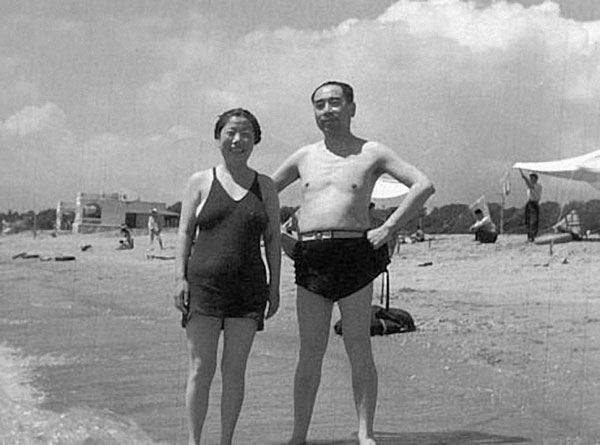 |
| Late Premier Zhou Enlai with his wife Deng Yingchao at the Beidaihe Beach Resort in 1954. Photo by Lyu Houmin / For China Daily |
The quaint seaside city has punched well above its weight in the political arena, hosting a seemingly endless parade of national leaders and serving as the birthplace of key government policies, many of which continue to affect the lives of countless Chinese citizens today.
Yet, Beidaihe didn't start out as a decision-making mecca.
The city grew in prominence as a vacation spot thanks to mild, year-long weather and a 22.5 km coastline. It is less than 300 km east of Beijing and, in the words of historian Zhu Guixin: "The sand of Beidaihe seashore is quite good quality, the beach is flat, and sharks are rare guests", according to Southern Weekly.
The area caught the attention of high-ranking officials in the late 19th century and was a holiday spot for Chinese warlords and the first waves of foreign diplomats and businessmen in the early 1900s.
Even so, it was not until half a century later that the area entered its golden age.
"In the early 1950s, a small government group finally confirmed Beidaihe as its summer work location after checking many places, including Dalian and Qingdao, for their environment, location and access routes," said Zhu.
In 1954, the Central Committee of the Communist Party of China started a tradition of moving its senior leadership to Beidaihe every summer for a working vacation.
Since then, Beidaihe has welcomed political leaders and heads of State, earning comparisons with the US presidents' Camp David in Maryland.
But Sun Zhisheng, an expert on Beidaihe culture, believes that comparison is unfair to China. He pointed out that Camp David is a resort exclusively for the US president, while Beidaihe has been utilized by a wide range of leaders.
From the founding fathers of New China to the current president, all have had vacations in Beidaihe.
According to reports, government leaders would bring projects and unfinished work with them while enjoying their visits. Many critical political decisions were made in the heavily guarded compounds in the heart of the town.
From 1954 to 1966, Beidaihe witnessed nearly every crucial meeting held by the central government in summer. The small town was frequently mentioned on the front pages of newspapers in China and abroad.
Among the world-changing events that began in Beidaihe was Mao Zedong's 1958 decision to shell Jimen island, the nationalist Kuomingtang's nearest post to the Chinese mainland after the group retreated to Taiwan.
Also, in the August of 1958, the Central political bureau, led by Mao, approved the nation's second Five-Year Plan (1958-1962) in Beidaihe. The decision to establish people's communes was also reached at the resort during the same period.
During this time, senior party officials regularly gathered in small meetings in Beidaihe to prepare for the National Congress, which is held in the autumn.
Proposals, strategies, deals, plans and backroom negotiations were all discussed and carried out in this quiet place, earning Beidaihe renown as China's unofficial summer capital.
Chairman Mao first visited the resort five years after the establishment of the People's Republic of China in 1949. It is widely known that Mao loved swimming there.
And Deng Xiaoping, the legendary reformist, stayed longer in Beidaihe than others. He usually returned to Beijing after celebrating his birthday with family in Beidaihe in mid-August.
Chinese leaders were not the only ones to enjoy the place.
Former US president George H. W. Bush and his family, including his son the former president George W. Bush, vacationed there when the elder Bush was chief of the US Liaison Office.
Despite the high-level interest, things weren't always so rosy in Beidaihe.
During the Cultural Revolution, from 1966-1976, the tradition of officials taking their summer vacation there was suspended for nearly a decade.
It was not until Deng initiated China's economic reforms in the 1980s that the tourists returned, and with them the politicians.
At one point, Beidaihe was given state sanction to help boost the tourist trade and in 1984 the summer tradition of high-ranking officials was restarted.
Political retreats resumed as usual until 2003 when a newly elected central government decided to once again call off the tradition of working in Beidaihe in summer
With its rich history, however, there was no way Beidaihe was going to fade away and high-ranking officials continue to pay occasional visits.
The most significant recent move came from the top. China's President Xi Jinping met in Beidaihe this summer with experts and talented people from around the nation who had been invited in honor of their contributions to the country.
If events such as this continue as scheduled, there is no way for the tiny political powerhouse of Beidaihe to slip in to the sunset like the sea.



Copyright 1995 - . All rights reserved. The content (including but not limited to text, photo, multimedia information, etc) published in this site belongs to China Daily Information Co (CDIC). Without written authorization from CDIC, such content shall not be republished or used in any form. Note: Browsers with 1024*768 or higher resolution are suggested for this site.
License for publishing multimedia online 0108263 Registration Number: 130349