 |
|
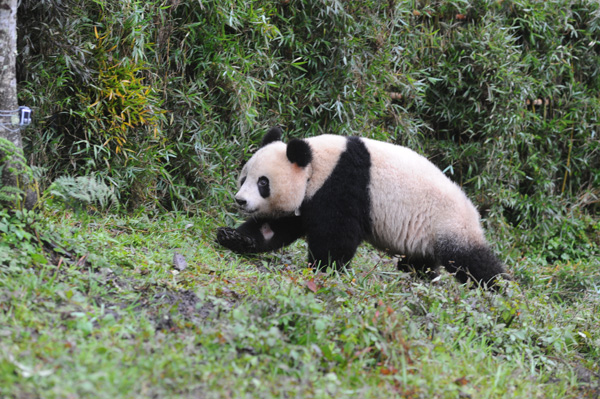
Giant panda Xue Xue is released into the wild at the Liziping Nature Reserve in Shimian in Southwest China's Sichuan province on Oct 14. After two years' training in habitat selection, foraging, and avoidance of natural enemies, it's believed the 2-year-old female will be able to survive in the natural habitat. Xue Xue was the fourth panda to be released, following Xiang Xiang, Tao Tao and Zhang Xiang. XUE YUBIN/XINHUA |
Changes to China's forestry management laws are helping to safeguard one of the world's best-loved animals, as Wang Qian reports.
In the past three years, Chen Xiaohong, a farmer in the mountainous province of Sichuan, has renovated his home and his family's income has doubled as a result of a new conservation model in Laohegou, a former State-owned farm with an adjoining forest.
|
SICHUAN'S BLACK AND WHITE SURVIVAL PROGRAM Forestry authorities in Sichuan province are investigating ways to build national parks to better protect giant pandas, possibly the world's best-loved animals. The Sichuan Provincial Forestry Bureau released a guideline in early October suggesting that nine migration paths for giant pandas will be the top options for the parks' locations. An official at the bureau who declined to be named said the construction of the parks is still in an exploratory phase and an environmental assessment is ongoing. Figures from the bureau show that Sichuan has 1,206 wild pandas, about 76 percent of the country's population, and their habitat covers about 17,700 square kilometers. In addition to building the parks, China has made efforts to reintroduce the animals into the wild, and expert Li Desheng said local authorities have made great efforts to protect the pandas and their habitat. On Oct 5, the Dujiang-yan Giant Panda Valley opened in Sichuan. It's the first center specifically designed to allow pandas to be introduced to the wild, and is home to more than 350 pandas. The valley has two specific areas where pandas are trained to live in the wild to ease their introduction to the natural habitat, plus a research and education center. The valley is located in forested hills, the panda's natural habitat, about 50 km from Chengdu, and is close to a nature reserve where a number of pandas live. The middle of October saw the fourth panda released into the wild in eight years. The program started in 2003, with the aim of training pandas to live on their own, with the first animal being released in 2006 after three years of being trained to survive in the wild. Late last month, the Sichuan Provincial Forestry Bureau announced that a new captive-panda training base will be built in the Liziping Nature Reserve, where four pandas have been released since 2006. |
"Just three years after the agreement was signed, my life has changed dramatically," Chen said, adding that the foundation has helped him sell farm produce such as honey and chicken in urban areas.
The 43-year-old farmer said that while the local farmers are prospering, the lives of animals such as pandas are improving. He compared the situation to that last seen in the 1980s, when the animals were seen more frequently.
Laohegou connects a number of nature reserves that provide an important migration path for pandas.
Jin Tong, a conservation scientist with The Nature Conservancy who also visits the Laohegou project, said: "We had been looking to introduce the land trust model to China to protect wild animals for a long time, but it wasn't possible until the forestry tenure reforms six years ago."
In 2008, the State Council, China's Cabinet, decided to promote the Collective Forest Tenure Reform, which allows 1.82 million sq km of woodland under collective ownership nationwide to be rented for commercial use.
Jin said the reform has enabled NGOs and individuals to establish private protected areas that protect the environment and biodiversity.
However, despite the opportunities for new conservation initiatives provided by the reform, a recent study showed that its implementation could also threaten the pandas' habitat. The study conducted by a team of researchers from Beijing Normal University showed that the reform would allow more than 15 percent of the pandas' habitat to be transferred to private investors for commercial use.
Zhang Li, a professor at the university who specializes in the protection of wild animals who led the study, said that without proper control measures the worst-case scenario is that reduction of the habitat could result in the country's panda population, currently numbering about 1,600, declining by about 15 percent.
Zhang said the reform has not yet fully been implemented in provinces with giant pandas, including Gansu and Sichuan, but it soon could be.
The study suggested that allowing individuals and NGOs to apply for eco-compensation from local and central governments could lessen the impact the reform may have on the pandas. It also provided four scenarios for the management of panda-inhabited areas under the reform, saying that if the government arranged an eco-compensation fee of about $1.2 billion, it would be possible to prevent the decline of the panda population.
"The study is intended to remind the forestry authorities that establishing an eco-compensation system is important in forest reform," Zhang said.
"Without proper measures to control the unintended effects of the reform, this change may pose a potential threat to these vital habitats as a result of commercial development," he added.
According to statistics released by the State Forestry Administration in 2004, the pandas' habitat nationwide has declined by nearly 60 percent in the past six decades, from 51,000 sq km in 1950s to 21,000 sq km in 2004, mainly as a result of deforestation and woodland fragmentation, human activity, and climate change.


Copyright 1995 - . All rights reserved. The content (including but not limited to text, photo, multimedia information, etc) published in this site belongs to China Daily Information Co (CDIC). Without written authorization from CDIC, such content shall not be republished or used in any form. Note: Browsers with 1024*768 or higher resolution are suggested for this site.
License for publishing multimedia online 0108263 Registration Number: 130349