


Friendships blossom across borders in verse







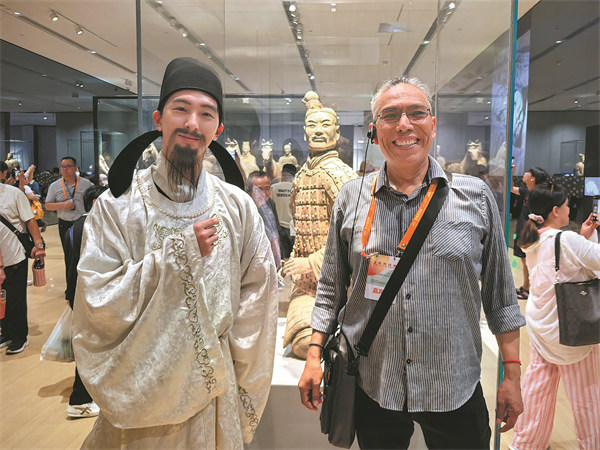
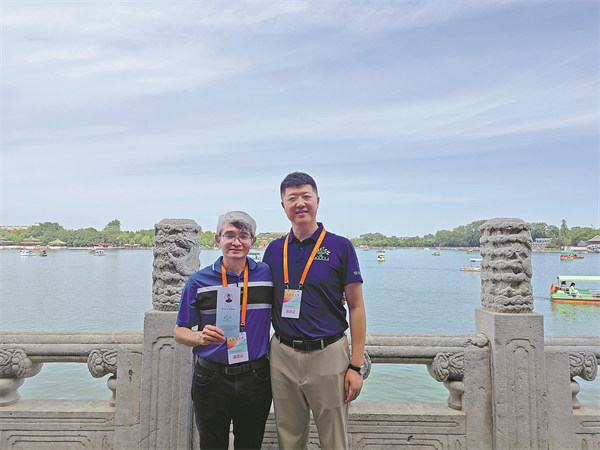
"At that moment, it was as if the great Tang poet had traveled through more than 1,000 years and become our shared confidant," Wang says.
"This coincidence and the gift are not only a testimony to literary exchange, but also a continuation of the friendship between the Chinese and Latin American peoples," he adds.
According to Li Zhen, a poetry critic and professor at Shaanxi Normal University, literary exchange between China and Latin America has a long and rich tradition.
One of the perfect examples, Li Zhen says, was the friendship between the renowned modern Chinese poet Ai Qing and the late Nobel Prize-winning Chilean poet and diplomat Pablo Neruda.
In his lifetime, Neruda visited China three times and left behind many timeless poems, such as Ode to New China and The Song of the Land of China, to express his admiration for the country.
In 1951, following his first visit to China in 1928, Neruda returned to the country and visited Beijing, where he befriended members of the Chinese literati, including novelist Mao Dun and poet Ai Qing.
Li Zhen says that Neruda liked Ai Qing a lot and described him as "charming" and a "prince of Chinese poets".
In the summer of 1954, Ai Qing traveled to Chile to attend Neruda's 50th birthday celebration.
"Ai Qing was suffering from writer's block, but the Pacific Ocean and the Chilean landscape gave him so much inspiration and spurred him to write the long, brilliant poem, On a Chilean Promontory, in tribute to the Chilean master," Li says.
Neruda's last visit to China was in 1957, and he spent his birthday on a cruise sailing along the Yangtze River. Ai Qing was the head of the Chinese delegation that guided him.
"It's exhilarating to see such an engaging exchange between Chinese and Latin American poets," Li Zhen remarks. "Even though we speak different languages, we are not much different when it comes to poetic thinking."
The critic also believes that such literary encounters provide poets with profound creative stimuli precisely because of the striking cultural differences shaped by the vast physical distance between China and Latin America.
The festival shows that, beyond Acuna, many Latin American poets — though separated by thousands of kilometers — share a deep connection with Chinese culture.
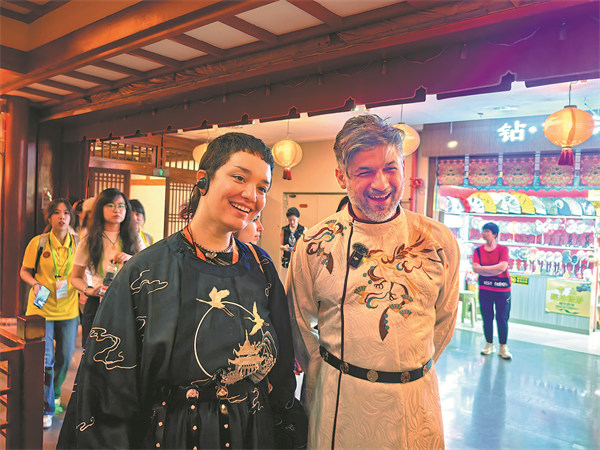
For example, Argentine poet and novelist Pablo Katchadjian revealed during a seminar held at the Qinling Mountains in Shangluo city, Shaanxi, on Sept 17 that he found intellectual nourishment in the Taoist classic Chuang Tzu (also known as The Book of Zhuangzi), which later guided him when he began practicing Wing Chun kung fu.
Katchadjian explained that martial arts had influenced his writing method: one should have a clear direction while remaining open to emerging possibilities, and even view obstacles as a kind of "hint of possibility".
Brazilian poet Ricardo Domeneck expresses similar inspiration. "I've always wanted to visit China because of Chinese poets Li Bai, Du Fu, Wang Wei and Lu Xun," he told this paper.
Domeneck notes that Chinese poetry values attention to detail and nature, and Chinese poets attempt to draw ethical or moral lessons from the way nature behaves.
"I think we have a lot to learn from Chinese poetry in that sense of seeing ourselves as part of nature, especially nowadays when we try to separate ourselves from nature," he argues.
Both Acuna and Domeneck say that what they've seen and experienced in China has inspired them to write new poems, and they look forward to turning them into books.
At a symposium on Sept 20, Zhang Hongsen, chairman and Party secretary of the China Writers Association, emphasized that the poetry festival aims to put the Global Civilization Initiative into action, encourage mutual learning between civilizations, strengthen people-to-people bonds, and help build a community with a shared future for China and Latin America.