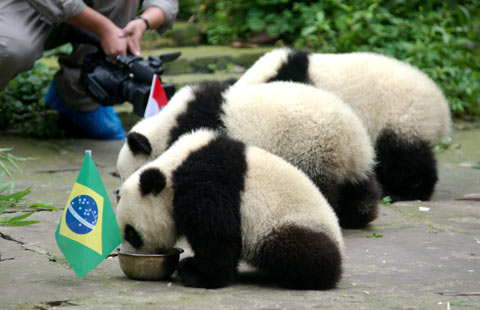
A new book highlights one of the world's most beloved and misunderstood animals. The authors share insights with Huang Zhiling in Chengdu.
At the Chengdu Research Base of Giant Panda Breeding, home to 118 captive pandas, many visitors get a sense that China has many pandas. So, they ask, how can we say they are an endangered species?
Major advancements in breeding techniques have secured the captive panda population. However, much greater effort is needed to preserve them in the wild as they remain extremely vulnerable to human intrusion into their native habitat, according to the new book Giant Pandas: Born Survivors published by the Penguin Group (Australia) in association with Penguin (China).
|
Zhang Zhihe, chief of the Chengdu Research Base of Giant Panda Breeding, says the rapid contraction of pandas' habitat is mainly due to human encroachment. Photos Provided to China Daily |
Co-authored by Zhang Zhihe, chief of the base in Southwest China's Sichuan province, and Sarah Bexell, director of conservation education and a research scholar at the Institute for Human-Animal Connection at the University of Denver in the United States, the book answers many questions about one of the world's most beloved - yet misunderstood - species, the giant panda.
Many who visit zoos think giant pandas are lazy, clumsy, have poor survival skills and are not good breeders. The book says this is based on observation of captive animals that do not need to forage for their food, the main activity of wild pandas which are active more than half the time, an average of 14.2 hours a day.
They are highly adept at negotiating their natural habitat and not clumsy at all. Their legs are stout and powerful with stronger fore legs than hind legs.
They walk with their toes turned in, giving them a clumsy appearance, but their sturdy legs allow them to move silently and with remarkable ease over precipitous terrain and through dense bamboo growth, in which humans are extremely clumsy.
Zhang and Bexell think pandas would do well if their habitat had not been decimated by humans. They say pandas are extremely adept breeders when left alone in their natural environment.
"The panda's penis size is often mentioned as a factor in unsuccessful breeding. Like many animals, pandas have diminutive penises, but size is not important for reproduction. What matters is the male's anatomy fits with that of the female and they live species-typical lives in order to learn proper mating rituals and methods. You might be interested to know they are endowed with sizeable testicles," Zhang says.
Jean Pierre Armand David, a French priest, was the first Western explorer to discover and document the giant panda in 1869. He was a famous naturalist for the Musee d'Histoire Naturelle in Paris.
During the 20 years he lived in China, he named and introduced 68 new bird species to the West, as well as over 100 insects and other mammals. He sent a panda specimen back to the museum's Henri Milne Edwards, who in 1870 published a paper declaring the panda a new species.
Giant pandas once enjoyed a very large range and their fossils were first unearthed in Myanmar in 1915 and in China in the early 1920s.
During the Pleistocene era, a period of geologic time from 2.58 million to 11,700 years ago, giant pandas were distributed from northern Myanmar to eastern China, and even as far north as the region around today's Beijing. According to local records, as recently as 1850, giant pandas still existed in western Hubei and Hunan provinces as well as in eastern Sichuan.
Today, pandas survive solely along the eastern edge of the Tibetan Plateau in six mountain ranges within Sichuan, Shaanxi and Gansu provinces, their habitat totaling about 23,000 square kilometers.
"The general consensus is that such rapid contraction must be ascribed to human population growth and land use rather than climate change," Zhang says.
With most valleys inhabited by humans, many pandas are isolated in narrow belts of bamboo no more than 1,000 to 1,200 meters in width.
"Therefore, their actual geographical range is much smaller than generally depicted on maps. Although the panda's total range encompasses 23,000 sq km, probably less than 20 percent represents their actual habitat," Zhang says.
Zhang and Bexell began working together in 1999, when Zhang joined the staff of the base as deputy director and Bexell was conducting giant panda behavioral research at the base for the United States' Zoo Atlanta.
Moved by the panda's plight, Bexell soon signed on to help the base develop the largest zoological education department in China. Shortly after, Zhang became the base director.
They had an immediate mutual respect for and interest in each other's work. They understood how crucial their respective areas of expertise were for the protection of giant pandas and their habitat.
Zhang specializes in veterinary medicine and genetics, and Bexell's areas of expertise are in animal behavior, conservation and humane education, the human-animal bond and international biodiversity conservation.
"Many species are in desperate need of help. So why focus on giant pandas? A major reason is their universal appeal and recognition. If we cannot rally humanity for a creature as universally appealing as the giant panda, what hope is there for the future of our planet as we know it today?" says Zhang.
Current rates of species extinction are greater than anything experienced on Earth since the cataclysmic natural event that caused the eradication of the dinosaurs 65 million years ago. Scientists estimate over half of the currently existing species may become extinct by 2100.
"It is urgent that humans come to understand that it is biodiversity in all its enormity and complexity that allows for our existence. It is biodiversity that provides and cleans our air and water, gives us food, protects us from diseases, buffers our storms and provides us with beauty and places of solitude. The biodiversity crisis we face today is partially the rationale for the production of the book," Bexell says.
"Scientists now believe biodiversity loss may pose the greatest threat to human survival and this issue requires our urgent attention," she says.
Contact the writer at huangzhiling@chinadaily.com.cn.

(China Daily 01/21/2014 page22)


Copyright 1995 - . All rights reserved. The content (including but not limited to text, photo, multimedia information, etc) published in this site belongs to China Daily Information Co (CDIC). Without written authorization from CDIC, such content shall not be republished or used in any form. Note: Browsers with 1024*768 or higher resolution are suggested for this site.
License for publishing multimedia online 0108263 Registration Number: 130349