 |
|
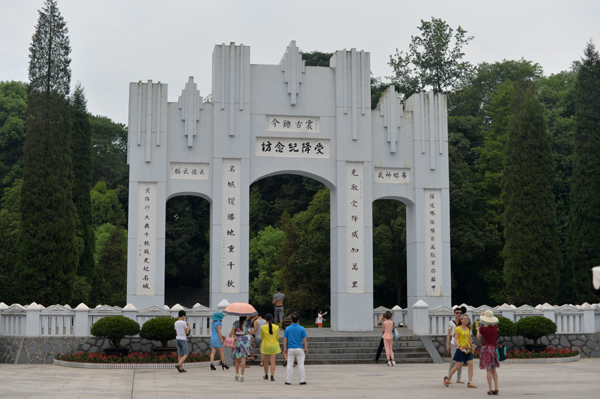
Tourists in front of the archway that commemorates the victory of the War of Resistance against Japanese Aggression on Aug 7. The archway was built in 1946. Bai Yu / Xinhua |
About 3.5 km out of the county to the west lies a stone bridge called the Qili Bridge, which means "3.5 km". A deep carving on the stone tablet at the head of the bridge reads "the place of the Japanese military surrender".
A tall memorial archway across the bridge is known as "China's archway of triumph". The Zhijiang Memorial Archway for Accepting the Surrender was built in 1946 with white stones and an image of the word "xue", or "blood".
About 50 meters north of the gate lies a row of black, single-storey wooden houses.
"That was where Japanese representatives signed the surrender document. The room has been well-preserved with everything kept in the original condition even after 69 years," said Song Meijiao, vice-director of the memorial's publicity office.
Surrender process
Japanese vice-general secretary Takeo Imai led a delegation of eight people and landed at Zhijiang Airport before noon on Aug 21, 1945. Before arriving at the site of the surrender ceremony, they drove around in three green jeeps with white flags to show their sincere apologies, Song said.
The Japanese aggressors' surrender was eagerly anticipated on the site. Military personnel and reporters filled the seats and people packed the rooms for a glimpse of the historic moment.
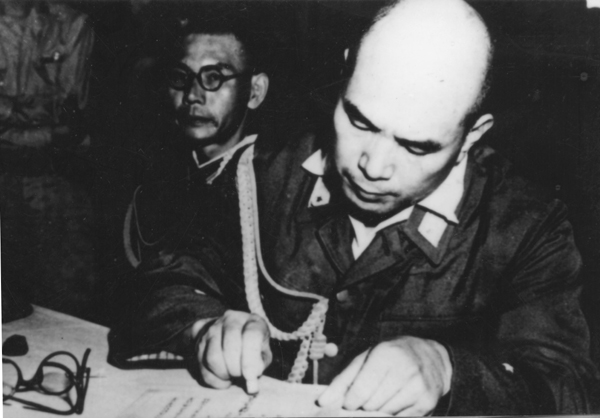
Photos exhibited at the Memorial Hall showed how the Japanese representatives were incessantly wiping sweat when faced with so many people during the ceremony.
One of them was Japanese infantry adviser Yoshio Hashijima, who handed over the military deployment map of the Japanese army as part of the ceremony, which was hosted by Chinese army chief of staff Xiao Yisu.
Japan had to refer to Germany's surrender because it did not have any experience in the ceremony, Wu said.
"The ceremony took about an hour, but the Japanese delegation also received detailed surrender instructions, including the arrangement of the 16 surrender regions, locations of the 100 sites where the Japanese military handed over weapons to the Chinese side proposed by Chinese general He Yingqin, and finalized various kinds of requirements of the surrender," he said.
From the time the Japanese delegation landed at Zhijiang Airport till their departure, the 52 hours fully prepared the Chinese armies nationwide for accepting Japan's surrender. It is an important and indispensable part of the World War II victory, he said.
"The site of the surrender is the only landmark in China to commemorate the War of Resistance against Japanese Aggression and World War II victories. It serves as a patriotic event binding Hong Kong, Macao, Taiwan and overseas Chinese to the mainland," said Wu.
Many consider the War of Resistance against Japanese Aggression as the first complete victory for Chinese people in the past century.
"While the Kuomintang government had received Japan's surrender on behalf of China in Zhijiang, that does not mean that the Communist Party of China and the anti-Japanese forces under the Party that fought at the enemy's rear, such as the guerilla attacks, did not contribute to the war effort," said Ma Zhendu, vice-curator of the Second Historical Archives of China.
"It is the joint efforts of both the Communist Party and the Kuomintang that effectively defeated the Japanese army. During the eight years of the War of Resistance against Japanese Aggression, the army led by the Communist Party had been involved in about 125,000 battles with the Japanese army and fought off more than 1.7 million Japanese invaders and forces of the puppet Chinese army. That proves that the Communist Party and its armies were pillars in winning the war," Ma said.
"The Chinese people had suffered tremendously in the war. The total number of China's military and civilian casualties hit 35 million. There is no doubt that the Chinese people made huge contributions to the victory of the world's anti-fascist war.
"In commemorating the role of Zhijiang in the war, we are also reminding the world to be alert to any threats of militarism and to cherish peace."
Contact the writer at hena@chinadaily.com.cn
 |
|
Japanese representatives stamp a document surrendering to the Chinese people in August 1945. Provided to China Daily |
Copyright 1995 - . All rights reserved. The content (including but not limited to text, photo, multimedia information, etc) published in this site belongs to China Daily Information Co (CDIC). Without written authorization from CDIC, such content shall not be republished or used in any form. Note: Browsers with 1024*768 or higher resolution are suggested for this site.
License for publishing multimedia online 0108263 Registration Number: 130349