 |
|
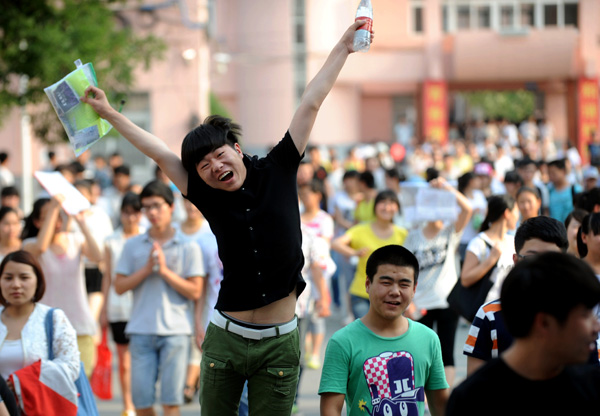
A student celebrates after the final day of the gaokao in June in Bozhou, Anhui province. Reforms of the national college entrance examination are viewed as urgent in order to provide fairer access to universities to all high school graduates, rich or poor. Zhang Yanlin / for China Daily |
Reform of the national college entrance exam became one of the most heated topics covered during the annual session of the country's top legislature in March.
Deputies of the National People's Congress gathered in Beijing to discuss the progress of the reform. They also expressed their hopes and concerns for the measures that would affect young Chinese people across the country.
The national college entrance exam, also called the gaokao, was launched in 1952 and resumed in 1977 after being suspended during the "cultural revolution" (1966-76). It has been a crucial, life-changing event for most Chinese high school students for decades.
The standardized exam aims to provide fair access to universities to all high school graduates, rich or poor. Universities also use it to help them select potential talent.
But there has also been criticism of the system, including concerns about corruption, regional discrimination and the huge psychological pressure that students suffer from the exams. These have helped fuel calls for more reform.
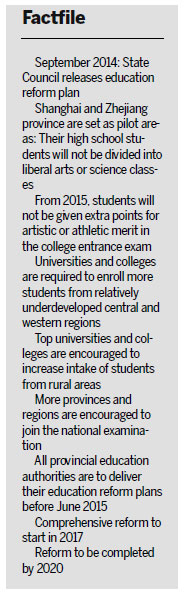
The education sector rolled out measures for change following a comprehensive plan for reform launched by the State Council in September.
"In 2015, universities will allocate another 20,000 seats for provinces in the middle and western areas to narrow the gap between provinces and regions with the lowest college enrollment rate and the national average," said Education Minister Yuan Guiren, adding that the reform will help ensure nationwide equality in higher education.
The ministry is working on policies to ensure equality and increase flexibility, he said.
Li Yuanyuan, president of Jilin University, saw the reform in a positive and optimistic way.
He believed that fairness is the essence of gaokao.
"Fairness is the bottom line of the reform, which will fail if the bottom line is ignored," he said, adding that universities are eager for the change because it provides more autonomy for them to choose suitable talent.
Under the current system, universities have less power to recruit students. They rely on one examination, unlike many universities in the West that have complete autonomy in choosing students.
Li also saw university self-discipline as an issue to address in the reform.
The plans for reform included a three-year transition and preparation for education authorities, changes in content and forms, and a reduction in all kinds of special recruitment such as enrolling students with artistic and athletic talent at lower scores and giving preferential policies to rural areas.
Pilot programs were launched last year in Zhejiang province and Shanghai. Comprehensive reform will begin in 2017.The reform should ideally be carried out by 2020.
But Ge Jianxiong, a history professor at Fudan University in Shanghai, firmly opposes the reform plan and "completely disagrees "with it.
"Our compulsory education is not about sending all students to universities. Instead, it is essential to guide the distribution of students, training 60 percent of them to be ordinary members of the labor force," he said, adding that without the appropriate distribution, students, parents and society will still hold the old view of making gaokao as the only way to success.


Copyright 1995 - . All rights reserved. The content (including but not limited to text, photo, multimedia information, etc) published in this site belongs to China Daily Information Co (CDIC). Without written authorization from CDIC, such content shall not be republished or used in any form. Note: Browsers with 1024*768 or higher resolution are suggested for this site.
License for publishing multimedia online 0108263 Registration Number: 130349