 |
|
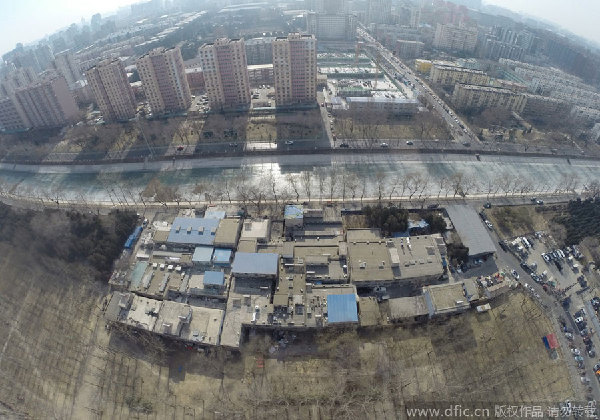
An aerial photo of the "Island of Cancer". It is a community made up of mostly people suffering from cancer or taking care of someone with the disease. [Photo/IC] |
BEIJING — Li Xiaohe has set herself up for the long haul in a cramped but sunny room in western Beijing, about a block from China's most renowned cancer hospital. Her laundry dries on hangers and her husband cooks in a communal kitchen as she embarks on an 84-day program of chemotherapy, following the removal of part of her right breast.
The youthful, soft-spoken 43-year-old, who works as a neighborhood watch leader back home in Henan province, is living in one of the many so-called cancer hotels that dot the neighborhood around the hospital, giving patients an affordable, cozy place to wait for appointments and undergo outpatient treatment.
With lung, bowel and breast cancer rates surging in China, such hotels have sprouted up in big cities such as Beijing and Shanghai, part of an ad hoc response to what medical experts say is a growing health crisis challenging the country's medical system.
"The treatment back home is different from here, so we came here," Li says in her bedroom, which is filled almost completely by her mattress. "At home, my insurance covers 85 percent of the cost. It'll be good if I can even get half of it covered here. But I'm doing this for my health. I'm looking for the right treatment."
These patients venture far for treatment believing they can't find adequate care in hometowns, instead preferring to camp out near reputable, big-city hospitals to await their turn for care. They do that even though government health insurance often covers less of the cost of care in Beijing and other big cities than it does back home.
The hotels, which mostly operate informally, don't provide nursing but put patients closer to medical services and experts, and give them a place to cook their own food and share tips with fellow patients.
Despite their name, they are not traditional hotels, but furnished units in apartment blocks near medical facilities, charging as little as $7 a night per room.
They reflect a health emergency that has seen the number of lung cancer diagnoses nationwide jump by 16 percent in two years, and the lung cancer rate in Beijing soar by 60 percent over a decade, according to Chinese government figures. Lung cancer mortality rates grew from around 50 per 100,000 men in 2000 to nearly 60 per 100,000 a dozen years later, World Health Organization data show. Breast cancer rates have also grown among women, killing almost as many of them yearly as lung cancer.
By comparison, male lung cancer mortality rates in the United States have dropped from 55 per 100,000 people in 2000 to 40 in 2012, and from almost 25 per 100,000 Brazilian men in 2000 to 20 in 2012, according to WHO.
Persistently high rates of smoking as well as toxic air pollution help explain much of the rise, said Angela Pratt, who leads WHO's work in China on tobacco control and non-communicable diseases such as cancer and heart disease.
"The rates of cancer, both the number of cases and the rates at which people are dying of cancer, are increasing in China, and that's obviously a cause for very significant concern," Pratt said. "That's a huge increase in a relatively short amount of time. I would say it's a critical situation."
Visible evidence of that surge fills the Beijing Cancer Hospital, where hundreds of patients, some still wheeling suitcases from their long journeys, fill the corridors waiting for hours to be called.
Cui Xiaobo, a newly retired social medicine professor at the Capital Medical University in Beijing, said sweeping health reforms that are still in the works would bring equal levels of care to people in cities and rural areas alike. Cui said rural doctors often aren't adequately paid, which requires that they squeeze in extra patients or suggest unnecessary treatments to bring in more revenue.
In his view, pollution couldn't yet be linked to rising cancer rates; instead, he said, much of the trend stemmed from higher life expectancy in China with the result that more elderly were being diagnosed with the disease.
"With cancer, there's no single cause," Cui said. "If there were a single cause, then it'd be easy to cure."
What's clear is the cancer surge in China is remaking the country. Experts have documented hundreds of cases of "cancer villages," or communities hit by higher-than-average cancer rates due to polluting nearby industries. In 2013, Chinese were shocked to learn of an 8-year-old girl billed as the country's youngest lung cancer patient, the result, her doctors said, of eastern China's choking air pollution.
Pratt said air pollution was clearly playing a role, as were smoking, unhealthy diets and obesity.
"Air pollution is now a recognized carcinogen, so there's no question that the hazardous levels of air pollution we're seeing in many parts of China are contributing to the increasing rates in particular of lung cancer," Pratt said.
Guo Xinglan is staying in the same three-bedroom apartment as Li near the Beijing hospital. They share a communal kitchen that has a refrigerator packed with anti-cancer medication.
Guo says she had never smoked before she was diagnosed with lung cancer several years ago. The woman from eastern Shandong province says her cancer has gone into remission but she still comes to Beijing yearly for a checkup.
"The doctor didn't say how I got this cancer," Guo says. "No one in my family has had it either. I know so many people in my area who are getting it."
The owner of the cancer hotel, retired merchant Chen Shuhong, said she's seen the need for her rooms near the hospital expand over the past decade. She started her business with an apartment left to her by an uncle who died at age 59 of lung cancer. She said she now rents 10 apartments that she offers as housing for cancer patients.
"People sought me out, so I opened this," Chen said. "If the government says, 'Don't do it,' then I won't do it. But so many people are getting this disease, and there's a need."


Copyright 1995 - . All rights reserved. The content (including but not limited to text, photo, multimedia information, etc) published in this site belongs to China Daily Information Co (CDIC). Without written authorization from CDIC, such content shall not be republished or used in any form. Note: Browsers with 1024*768 or higher resolution are suggested for this site.
License for publishing multimedia online 0108263 Registration Number: 130349