 |
|
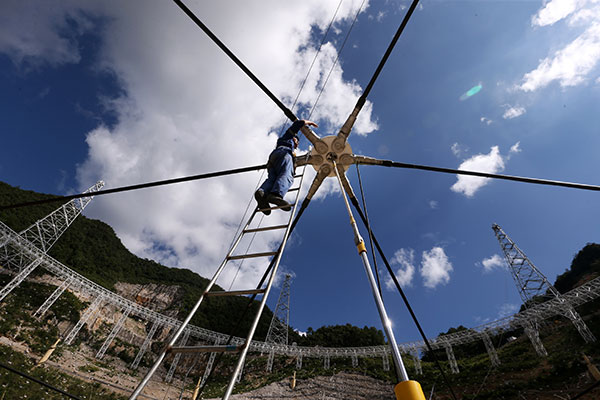
A worker examines links on the aperture spherical radio telescope in Guizhou province. Xu Qifei / Guiyang Evening News |
The installation of reflectors on the world's largest radio telescope has begun, marking the start of a final key stage of the telescope's construction.
Located in a natural valley of Southwest China's Guizhou province, the 500-meter aperture spherical radio telescope, known as the FAST Project, had its first reflecting unit installed in early August.
Wuchang Shipbuilding Industry Group, a company in Hubei province responsible for installing the reflectors, said the reflector surface, with a diameter of 500 meters, consists of 4,450 reflecting units. About 20 units can be installed a day, and the installation is due to be completed by March next year.
FAST is a key national project and received funding of 1.2 billion yuan ($190 million) when construction began in 2011.
Zhang Haiyan, deputy director of the FAST Project's general office, said the telescope will take the place of the 305-meter-diameter Arecibo Observatory in Puerto Rico as the largest of its kind in the world.
The sensitivity of the telescope will be more than 10 times stronger than that of a 100-meter telescope near Bonn, Germany, Zhang said. Scientists believe more discoveries and breakthroughs are expected after construction is completed in September 2016.
Site selection
Construction of the telescope was first proposed by astronomers from 10 countries, including China, in 1993. A year later, astronomers made several site-selection trips to southwest China, analyzing 400 natural basins.
One in Pingtang county, Guizhou province, was finally chosen for its almost-perfect spherical landform, which saved much effort in digging a hollow for the telescope, said Li Di, a scientist at the National Astronomical Observatories of the Chinese Academy of Sciences.
Zhu Boqin, an engineer who took part in the site survey more than 20 years ago, said the valley in Guizhou was also chosen for its karst formation of soluble rocks that ensures good drainage. This meant that rainwater would not gather to damage the reflecting surface of the telescope.
Additionally, radio interference from the surrounding area is low, since there is only one town within a radius of 25 kilometers, Zhu said.
In 2007, funding for the project was approved by the National Development and Reform Commission. Two years later, the 65 residents of the valley, from 12 families, were moved to a town nearby.
On March 25, 2011, construction of the project officially kicked off, with a planned completion date in 2016.


Copyright 1995 - . All rights reserved. The content (including but not limited to text, photo, multimedia information, etc) published in this site belongs to China Daily Information Co (CDIC). Without written authorization from CDIC, such content shall not be republished or used in any form. Note: Browsers with 1024*768 or higher resolution are suggested for this site.
License for publishing multimedia online 0108263 Registration Number: 130349