 |
|
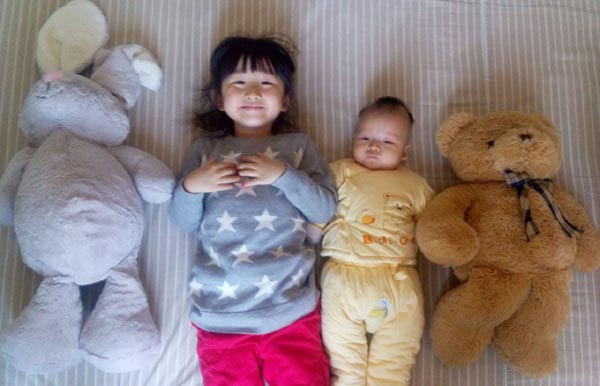
Li Shuchun, 4, and his 7-month-old brother Li Shuhan, live in Beijing with their parents who are among the 1.07 million out of 11 million eligible couples applied to have a second child by the end of last year. [Photo by Wang Nina/Provided to chinadaily.com.cn] |
BEIJING - China will allow all couples to have two children, abandoning its decades-long one-child policy, the Communist Party of China (CPC) announced after a key meeting on Thursday.
The change of policy is intended to balance population development and address the challenge of an ageing population, according to a communique issued after the Fifth Plenary Session of the 18th Communist Party of China (CPC) Central Committee held from Monday to Thursday.
Demographic experts say the move, as leaders map out the country's economic and social development plan toward 2020, will help the country achieve its short-term and long-term goals.
After taking into accounts the proposal, a final plan will be ratified by the annual session of China's top legislature in March.
It will further ease the world's most populous country's family planning policy after the Third Plenary Session of the 18th CPC Central Committee in November 2013 ruled that couples are allowed to have two children if one of them is an only child.
Li Bin, head of the National Health and Family Planning Commission, said after the release of Thursday's communique that the two-child policy will optimize the demographic structure, increase labor supply, ease pressure from the ageing population, and help improve the health of the economy.
Li added that the commission will increase services in maternal and child health as well as build more kindergartens.
A just-married 27-year-old woman surnamed Wang in Beijing is one of the people set to benefit from the change. Wang has an elder sister and her 31-year-old husband has an elder brother.
"Both of us want to have two children because we were raised in two-child families, and we enjoy it," she said. "We knew that the one-child policy would be abandoned at some point, but we never thought it would come so soon. It's come in time for us!"
According to the National Bureau of Statistics, China had a population of 1.368 billion at the end of 2014, while India, with the world's second largest population, has about 1.25 billion people.
China's family planning policy was first introduced in the late 1970s to rein in the surging population by limiting most urban couples to one child and most rural couples to two children, if the first child born was a girl.
The policy was later relaxed to say that any parents could have a second child if they were both only children.
Lu Jiehua, a sociologist with Peking University, noted that a second step in relaxing the birth control policy was promised by the government at the time of its 2013 easing.
Since its implementation, the one-child policy has resulted in an estimated reduction of some 400 million people in China, successfully containing over-population.
However, it has also been blamed for generating a number of social problems, especially a decreasing labor force and an ageing population.
According to official data from 2014, China had over 212 million people above the age of 60, and 137 million above 65, accounting for 15.5 percent and 10.1 percent of the population, respectively.
China's labor force in 2012 reached a peak of 940 million, and decreased to 930 million in 2014. It is estimated that the labor force will decrease by about 29 million in the decade ending in 2020.
Yuan Xin, a professor with Tianjin's Nankai University, said the new policy will definitely reduce the ageing problem in the long term, "but there will be little outcome in the short term. By 2050, the proportion of the ageing population will be reduced by 1.5 percent."
The new policy will slow the shrinkage of the working-age population. However, China will still suffer from a surplus in total labor force and a structural shortage of talent.
According to Lu, in the short term, being able to have two children will benefit about 100 million families around the country.
However, it will take time to show any real effect, according to the professor, who believes couples will take a rational attitude. "Couples born in the 1970s may want to have a second child as they want to 'catch the last bus,' but those born in the 1980s and 1990s have no urgent desire to give birth to a second child."
The experts said the change of the policy does not reflect badly on the one-child parents.
"It was a choice based on historical conditions, and it is right that policies should be adjusted constantly to adopt to demographic change," said Yuan.
Lu said the new policy will help China meet the development goals set in the 13th Five-year Plan that the recent CPC plenary session discussed, especially in the situation that slowing economic development needs more population to increase the domestic demand.
The CPC Central Committee said in the communique that the 13th Five-year Plan is a key stage for building a well-off society by 2020, one of the CPC's "Two Centenary Goals," another being building a modern socialist country by 2050.
"The policy change is a must for China to take a sustainable path toward the two goals," said Yuan.


Copyright 1995 - . All rights reserved. The content (including but not limited to text, photo, multimedia information, etc) published in this site belongs to China Daily Information Co (CDIC). Without written authorization from CDIC, such content shall not be republished or used in any form. Note: Browsers with 1024*768 or higher resolution are suggested for this site.
License for publishing multimedia online 0108263 Registration Number: 130349