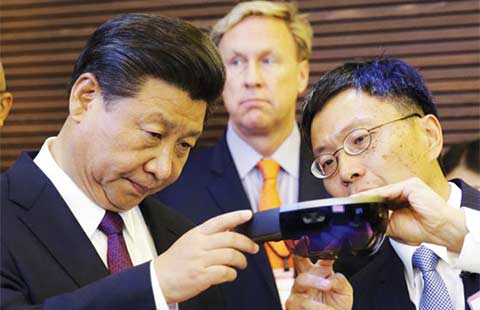
BEIJING - By 2020, China-developed artificial intelligence will be smart enough to gain admission to leading universities through the gaokao, China's national college entrance exam.
"Our goal is to make our robots smart enough to enter first-class Chinese universities in three to five years," Liu Qingfeng, president of tech firm iFLYTEK Co. Ltd., said Monday at the company's annual launch in Beijing.
Liu believes artificial intelligence has three layers: computational intelligence, perceptive intelligence and cognitive intelligence. Robots have rivaled or surpassed the human brain in the first two layers. However, artificial cognitive intelligence, the ability to think and understand, is far more challenging.
"We have found the only way to crack cognitive intelligence," Liu says. He and his company hold that human cognitive intelligence is the result of collision of thought, formed through oral or written communication. "So the key is speech and language."
Teacher's assistant
"It is easy for a robot to sit the gaokao because machines are strong in memory," Liu says. "But it is hard for them to surpass 80 percent of human candidates and qualify for first-class universities."
The A12 lab of University of Washington, he says, is aiming to pass the American College Testing biology exam. Japan's Todai robot has the goal of competing with other students who want to enter the University of Tokyo by 2021.
Science tests such as math, physics and chemistry are relatively easy for AI because they can be solved with mathematical statistical models, Liu says. Japan's robots have reached the level of an average student in multiple choice exams in math and physics.
The liberal arts - or more specifically, natural language understanding (NLU) - are tougher. "A composition in language or a history test is the most difficult," Liu says. "NLU is what iFLYTEK focuses on."
While the target is set, the ultimate goal is not to beat the human brain, but to advance human intelligence.
"Most schools never satisfy all students," Liu says. Fast learners find their time wasted in class while slow learners feel frustrated if they cannot keep up. Teachers must often spend time grading answer sheets instead of helping underachievers.
"Thanks to the technology of handwriting recognition, speech recognition and automatic grading, AI can meet each student's needs and lessen the teacher's burden now." Liu shows how robots can recognize notes on a piece of homework and give it a score. It can also identify a student's weakness in his or her answer so the student can improve.
South China's Guangdong Province has already used iFLYTEK's grading system in the gaokao English oral test.
More than 80 million Chinese teachers and students are already benefiting from iFLYTEK's education products and Liu believes the market in customized education is potentially huge.
Journalist's helper
As Liu addressed the audience, two big screens on each side of the stage were transferring his speech into text through a product called Iflyrec.
For journalists present this seemed like a long-overdue innovation, but Liu said it had posed many difficulties.
He raised the example of the smart home. If you want to control the electric appliances by voice, AI must recognize your voice by suppressing noise in the house. When you are talking with the television on, the robot must cancel the sound of the TV. If you want the air conditioner to hear you from 5 meters away, the AI must "grasp" far-field speech recognition that enables it to pick up the sound from a certain distance and from all directions.
"Another difficulty lies in discourse understanding, which includes smoothing out the text, adding punctuation, erasing irrelevant content and understanding informal language," he says.
As the words flowed on the screens, five stenographers competed with the machine in shorthand. After assessing a random extract of 1,000 words, the robot won with an accuracy rate of 99.29 percent, compared to 80.84 percent for the best stenographer.
"With this technology, captions can be generated automatically on film," Liu says.
Asked if robots might replace human reporters, Hu Yu, vice president of iFLYTEK, replies, "Rest easy - robots excel in computation and, of course, they are better compilers of data. But they cannot create stories."
In the foreseeable future, Hu says, AI will help with simple brainwork. As for sophisticated brainwork, "we will maintain exclusive ownership."
Thinking machine
"A father cannot lift his son because 'he' is too heavy." Can a robot tell who is "he" ?
"This question is very easy for humans, but too hard for a robot," Hu says. To answer requires the machine to be able to comprehend the sentence.
iFLYTEK initiated its "Hyper Brain Project" last year, with the aim of developing AI cognitive intelligence. "This cognitive revolution revolves, on the surface, around NLU, but by nature, it's cognition of the whole world, the universe and human society," Hu says.
"A cognitive intelligence system is developed on the basis of perceptive intelligence," Hu says. "When you see the face of a cat, the concept of cat soon forms in your brain. You begin to think of its mew and how its fur feels."
iFLYTEK has developed neural machines for collecting perceptions, such as visual and audio information. When they have enough information, it will be gathered by a Neural Thinking Machine for reasoning and making conclusions, so that we can make better decisions. The result of the decision will be expressed via a Neural Expressing Machine, forming a closed loop that contains all of a human's intelligence.
"We don't have to copy the brain," Hu says. "Our job is to find the true principles and secrets of brain."
Such developments inevitably raise the prospect of a Terminator-style rebellion of the machines.
Hu says advances in AI will lead away from such fictions. "The more we learn from our brain, the better we can divide intelligence from self-consciousness, namely our emotions, good and evil. In the future, robots will be able to harness more intelligence, but not self-consciousness."


Copyright 1995 - . All rights reserved. The content (including but not limited to text, photo, multimedia information, etc) published in this site belongs to China Daily Information Co (CDIC). Without written authorization from CDIC, such content shall not be republished or used in any form. Note: Browsers with 1024*768 or higher resolution are suggested for this site.
License for publishing multimedia online 0108263 Registration Number: 130349