BEIJING -- China is to invest more than 1.6 trillion yuan ($260 billion) in infrastructure in an economy where growth is expected to slow and fiscal deficit increase.
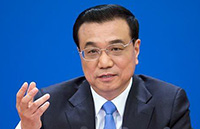
China will invest over 800 billion yuan in railway construction this year while investment in major water conservancy projects will exceed 800 billion yuan, according to a government work report delivered by Premier Li Keqiang Thursday.
China will increase effective investment in public services, Li said.
Over 8,000 kilometers of railway track will be opened to traffic this year and construction on the 57 ongoing major water conservancy projects must be accelerated, he identified, adding that 27 more projects will start this year.
"China still has significant infrastructure needs. Capital stock is close to the level seen in the US in 1969. That means there is considerable room for productive investment," said Tom Orlik, Bloomberg chief Asia economist. "With investment in real estate and manufacturing slowing, stronger spending on infrastructure could help underpin growth."
Also announced were widely-expected measures to slash red tape, facilitate public-private partnerships and reduce foreign investment restrictions, which will bolster market activity.
China may face more economic difficulties in 2015 than last year, said Li in the report, with domestic investment, consumption and the international market all under pressure.
China lowered the growth target of the gross domestic product (GDP) by half a percentage to around seven percent for 2015, after the economy registered 7.4 percent expansion last year, the lowest in 24 years.
"The current economic growth rate remains weak and the government feels the need to step up proactive economic policies to counter headwinds," said Zhao Yang, China chief economist of Nomura, Japan's leading financial institution.
"The more proactive macro policies will reduce the risk of an economic hard-landing," said Zhao.
The government will build an additional 7.4 million new urban apartments for low-income residents and renovate 3.66 million substandard rural houses.
Continuing a proactive fiscal policy, China will see its fiscal deficit target increase from 2.1 percent of GDP to 2.3 percent, below many economists' expectations of above 2.5 percent.
Out of the planned 1.62 trillion yuan deficit, 500 billion is slated for local governments.
The move is necessary, said experts, especially considering China's local government financing vehicles have been hampered.
"It will require an increase in fiscal deficit target or alternative financing schemes [e.g. public-private partnership] to avoid a fiscal drag on economic activity," wrote Haibin Zhu, J.P. Morgan China chief economist, in a preview of the legislative sessions.
Spending priorities include agriculture, living standard improvements and environment protection, but using taxpayers money will come under greater scrutiny, according to Li, who promised that budgets and final accounts, of all levels of government, will be made public.
The premier emphasized on maximizing effectiveness of government funds, a first in his government work reports, calling for their better use instead of being left idled.
"On fiscal policy, implementation will be crucial. In past years the deficit has come in considerably below target," wrote Bloomberg economists Tom Orlik and Fielding Chen in a preview.
However, the government aims to to roll out more proactive policies to encourage capital, both domestic and foreign, into more areas to stimulate the market, said Li.
On the monetary side, China lowered the growth target of M2, a measure of money supply, from 13 percent to 12 percent, as expected by economists.
Experts say this in line with the tone of December's Central Economic Work Conference, which said "proactive fiscal policy should be stronger, and the prudent monetary policy should be more focused on striking a proper balance between being tight and loose."
"In the past, monetary policy has done the leg work of supporting growth, with fiscal policy staying conservative. Now, with banks overextended and central government debt low, those roles are reversing," wrote the Bloomberg economists.
Recognizing that the investment announced are significant but smaller than the 4 trillion yuan package China rolled out in the 2008 global financial crisis, experts believe the investment could cushion economic growth and improve the economic structure.
"Acknowledging that the Chinese economy has entered a new normal of slowing down and restructuring, the government only needs to provide mild stimulus on the front of macroeconomic policies," said Nomura's Zhao. "China still has much room to build infrastructures in areas such as public transportation and environment protection."
Related Stories
Copyright 1995 - 2015 . All rights reserved. The content (including but not limited to text, photo, multimedia information, etc) published in this site belongs to China Daily Information Co (CDIC). Without written authorization from CDIC, such content shall not be republished or used in any form. Note: Browsers with 1024*768 or higher resolution are suggested for this site.
License for publishing multimedia online 0108263 Registration Number: 130349