 |
|
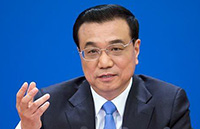
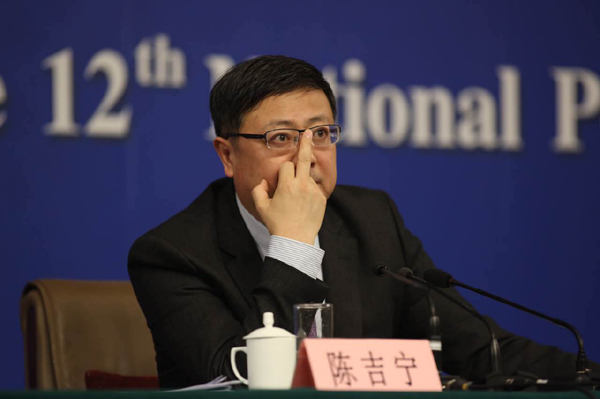
China's Environmental Protection Minister Chen Jining listens to a question at a press conference on the sidelines of the ongoing annual session of the National People's Congress, China's top legislature, in Beijing, March 7, 2015. [Photo by Wang Jing/chinadaily.com.cn] |
In response, the novice minister warned that graft in environmental impact assessments should never be tolerated, vowing to crack down on illegal mediation between polluting enterprises and the watchdogs.
Chen promised to speed up China's pollution control with economic leverage including legislation on environmental protection tax.
Environmental protection is an important growth driver for China, he said, stressing that the demand for investment will be huge in years to come.
According to the minister, the market for environmental protection in China will be worth around 8 trillion yuan (1.3 trillion U.S. dollars) to 10 trillion yuan in the next few years.
Such investment provides "good momentum" for economic growth, he added.
Currently, the government provides about 30 to 40 percent of the funding for environmental protection. Experts believe the private capital needs to be given fuller access to this market.
Chen said that his ministry will advance price reform to build a mechanism for measuring project returns and ease market access by means such as public-private partnerships. He also said that China will cooperate with other nations and international organizations in the battle against pollution.
His remarks came months after Beijing and Washington, the world's two leading emitters, reached a historic climate deal, in which China is committed to increasing the share of non-fossil fuels in primary energy consumption to around 20 percent by 2030.
Chen's promise also came in advance of a new universal climate agreement expected to be inked in Paris in December.
The minister urged developed countries to take the lead and offer more capital and technological assistance to developing countries to tackle climate change.
He voiced hope that parties attending the Paris climate conference will respect the UN Framework Convention on Climate Change and follow the principle of common but differentiated responsibilities to reach an agreement as soon as possible.
Pollution has remained a hot topic at China's annual sessions of the top legislature and political advisory body.
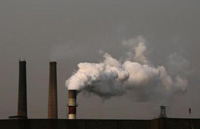
Talking about the smog that has been blanketing most of China, Chen said "extra efforts" should be made.
More than 80 percent of about 300 monitored cities failed to meet the official standard of air quality last year, with smog most frequently hitting the Yangtze River and Pearl River deltas as well as the Beijing-Tianjin-Hebei region.
"No country in the world is making such great efforts as China to combat air pollution," Chen said.
The government will strengthen implementation of the revised environmental protection law and improve pollution controls, he vowed.
As China is gearing up for a slower but more self-sustaining growth, observers have warned that as the country's coastal regions turn against pollution, low-end manufacturers and factories may be relocated to the poorer central and western regions that are desperate for investment.
Chen pledged not to let this happen: "We will not allow the central and western regions to become a harbor for polluting enterprises."
He also vowed to pay more attention to pollution in China's countryside, where the the amount of pollutants is also on the rise.
The central government allocated 25 billion yuan to deal with rural pollution at the end of 2014.
While the fund is expected to cover 59,000 villages and benefit 110 million people, it still looks inadequate compared with spending on urban pollution.
"Problems such as administration loopholes, weak public awareness and lack of supervision still exist," said Qin Dahe, an academic with the Chinese Academy of Sciences.
He suggested long-term planning with a focus on promoting green techniques.
Related Stories
Copyright 1995 - 2015 . All rights reserved. The content (including but not limited to text, photo, multimedia information, etc) published in this site belongs to China Daily Information Co (CDIC). Without written authorization from CDIC, such content shall not be republished or used in any form. Note: Browsers with 1024*768 or higher resolution are suggested for this site.
License for publishing multimedia online 0108263 Registration Number: 130349