|
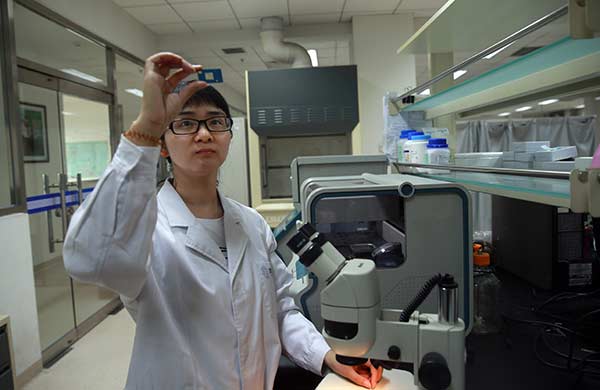
Researcher Xie Lan, chief biochip designer, checks a biochip at the development center in Beijing. Zou Hong / China Daily |
Because most healthy men can produce large amounts of sperm - 1 milliliter of semen contains more than 15 million sperm on average - the quality attracts less attention than problems related to human eggs.
However, clinical research shows another side to the story.
Peking University Third Hospital - the country's leading center for infertility problems - studied notes collected between 2004 and 2008 about more than 50,000 cases.
The results of the research indicated that the proportion of viable sperm in each milliliter of semen declined from 47.27 percent to 32.97 percent over the four-year period.
Moreover, the number of patients with a negligible sperm count rose from 6 to 10 percent, while those with a low sperm count rose from 60 to 85 percent during the same period.
Last year, more than 125,000 patients attended the hospital's andrology department. The number was six times higher than in 2009, and about 50 percent of the patients had infertility problems. "After the relaxation of the family planning policy, the number of patient visits has climbed by nearly 30 percent," said Jiang Hui, the director of the department.
"More men are facing fertility problems, despite a rise in the number of medical staff available to treat them, and people's increasing awareness of reproductive health," Jiang said. "A number of factors are to blame, including environmental pollution and the pressure of work."
The fusion of a sperm and an egg is the beginning of human life. The health of sperms and eggs is equally important, irrespective of whether the child is conceived via natural conception or through the use of human-assisted reproductive technologies.
In most public hospitals, sperm testing and evaluation mainly focus on three basic functions: sperm count, motility (the sperm's ability to move), and morphology (the shape and appearance of the sperm).
The development of medical science has resulted in the discovery of a wide range of factors that determine whether a sperm can find the egg and swim in the right direction to achieve a successful union.
"The uterus is like a big maze. To swim from the vagina to the fallopian tubes and find the egg is never a coincidence," said Xie Lan, a researcher at Tsinghua University who led the design of the biochips. "In the process, the sperm's chemotaxis (the movement of organisms as a reaction to chemical stimulus) and thermotaxis (movement of an organism toward or away from heat sources) are the other two major factors."
Xie said human eggs release a chemoattractant, a chemical that signals their position to sperm, while the difference in temperature between the cooler sperm reservoir and the warmer fertilization site also prompts the sperm to swim in the right direction.
"Clinical assessment of the two indexes is currently lacking. We constructed two micro-devices with channels shaped like the system inside the female reproductive tract. Sperm are permitted to swim freely without any coercive force, so they can be tested without damaging them," she said.
Motility and chemotaxis are tested on one biochip. Motile sperm will be the first to arrive at the end of a straight "running channel", which is connected by two sub-channels to test the sperms' response to various concentrations of chemoattractant.
Thermotaxic evaluation is undertaken on a second biochip. Temperature-sensitive sperm are attracted to the sub-channel with a high temperature setting, while non-responsive sperm are evenly distributed across the two sub-channels.
In the two tests, about 10 percent of motile sperm were found to be chemotactically responsive, while 5.7 to 10.6 percent showed a thermotactic response.
Experiments have yet to be conducted to establish the number of responsive sperm in both tests.
"But the number might be low, between 5 to 10 percent. The tests can possibly explain some unknown problems with pregnancy, and contribute to sperm selection for IVF," Xie said, adding that work is underway to try and combine all three tests on one biochip.



Copyright 1995 - . All rights reserved. The content (including but not limited to text, photo, multimedia information, etc) published in this site belongs to China Daily Information Co (CDIC). Without written authorization from CDIC, such content shall not be republished or used in any form. Note: Browsers with 1024*768 or higher resolution are suggested for this site.
License for publishing multimedia online 0108263 Registration Number: 130349