|
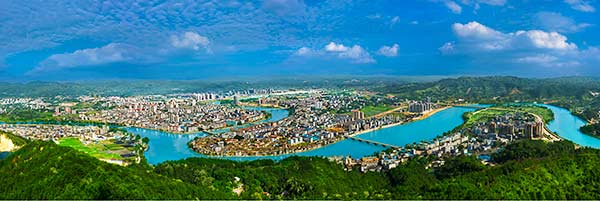
A panaromic view of Huichang county in Jiangxi province. Li Jianping / For China Daily |
Editor's note: For many foreigners traveling in China for the first time, the country's sheer size and uneven development can be both baffling and bewildering. The world's second-largest economy boasts a per capita GDP of $8,000, yet at least 70 million people are still living in absolute poverty, earning less than the official poverty line of 2,300 yuan ($361) a year. On the affluent east coast, boys and girls are scampering for coveted tickets to Shanghai Disneyland, which is scheduled to open in mid-June. But hundreds of miles west are broad swathes of barren mountainous areas, where some schoolchildren have to use rope ladders to scale 800-meter cliffs just to get to school. The central government wants all those living in China to at least have adequate food and clothing plus access to education, basic medical services and housing. The money and manpower mobilized for this endeavor must precisely target those in need. Hence the vision of "taking targeted measures in poverty alleviation", as President Xi Jinping said last year. With this vision, Xi has pledged to lift all the remaining poor - 70 million - out of their plight within five years. Like many government agencies, organizations and businesses in Beijing and beyond, China Daily has also been engaged in this poverty-relief campaign over the years. In several batches, we have sent staffers to Dongxiang county in Northwest China's Gansu province, and Huichang county in East China's Jiangxi province. These two regions are among the most vulnerable to the specter of poverty. We have helped them carry out development projects and train teachers for local schools. But most often, we've dispatched reporters, in teams of two and three, to tell the stories of the grassroots regions. These reporters spend several weeks in a county with farmers, chronicling their everyday life and how the local cadres help the residents lift themselves out of poverty. From today, we will publish a series of reports on Huichang county, a land that is rarely seen by foreigners yet abundant with untold stories.
|
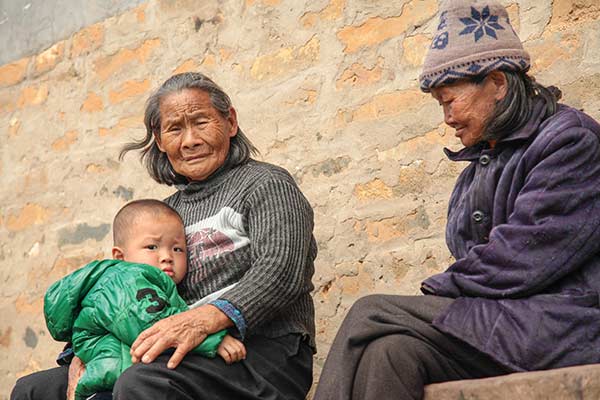
Villagers sit in the sun at Yangjiao Water Castle in the old town of Junmenling. |
A chance to experience life in a military castle built nearly 550 years ago, an excursion to rugged mountain vistas high up in the pristine air and a glimpse of a vibrant county striving to break free of poverty.
This is what Huichang, in Jiangxi province, promises visitors - a haven for curious tourists who are tired of the crowds.
It is said that the county got its name in AD 982 during the Northern Song Dynasty (960-1127), when an ancient brick bearing the characters for hui chang, which literally means "will prosper", was unearthed while digging a well.
More than a thousand years later, Huichang has seen some prosperity - the income of farmers in the area posted a 14 percent rise last year, and most residents now own at least one mobile phone. But the county, which at 2,700 square kms is roughly the same size as urban Miami in Florida, seems not to have fully lived up to the expectations of those who named it.
For one, it has yet to lift 47,000 people, or about one-tenth of its population, out of poverty. These people, many of whom are illiterate, live on an annual income of less than 2,300 yuan ($365) - the poverty line below which 70 million Chinese still live.
However, under the national poverty-relief program, Huichang is entitled to a slew of preferential policies and financial support for its development projects, which are designed to help lift all of its poor out of poverty by 2020.
The county sits at the confluence of two waterways that go on to form the Gan River, a principal southern tributary of the Yangtze River and the lifeline of Jiangxi province.
In ancient times, people from northern China used these rivers to travel or migrate as far as Junmenling in southern Huichang county, a mountainous town that serves as a gateway to the neighboring Fujian and Guangdong provinces in South China.
At least 95 percent of Huichang's population come from the Hakka ethnic group - one of the highest concentrations in the country.



Copyright 1995 - . All rights reserved. The content (including but not limited to text, photo, multimedia information, etc) published in this site belongs to China Daily Information Co (CDIC). Without written authorization from CDIC, such content shall not be republished or used in any form. Note: Browsers with 1024*768 or higher resolution are suggested for this site.
License for publishing multimedia online 0108263 Registration Number: 130349