Experts say G20 crucial for science
|
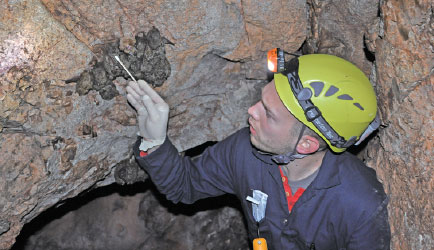
Joseph Hoyt, a student from University of California Santa Cruz, conducts field research to learn whether China has a fungus deadly to bats. He is collaborating with a research group from Northeast Normal University in Changchun, Jilin province.? Provided To China Daily |
More exchanges advised for young researchers, who represent 'the future' of innovation in world
As a country with the world's largest number of scientific researchers, China is benefiting and will continue to benefit from scientific exchanges and cooperation with other G20 members, particularly in exchanges of talent and young research staff, officials and scientists said.
Zhao Xinli, deputy director of the China Science and Technology Exchange Center, said the G20 is the largest and most important group in technological innovation worldwide. Cooperation and innovation under the G20 framework will not only benefit the members, but it is also of great importance to the sustainable development of the world.
The center is an institute under the Ministry of Science and Technology that fosters scientific exchanges and cooperation internationally.
According to the China Science and Technology Talent Development Report, which was released by the ministry last year, China's human resources in this area exceeded 71 million people as of 2013, ranking it No 1 in the world.
Meanwhile, the latest statistics from the World Bank Group and the United Nations Educational, Scientific and Cultural Organization showed that the research and development investment of 19 G20 members, excluding the European Union, accounts for 87 percent of the world total, with the academic papers that these members publish accounting for 76 percent of the world total and applications for patents from these members accounting for 97 percent.
Zhao, who is also the coordinator of the G20 innovation agenda, strongly suggested more frequent exchanges and mutual visits of young research staff.
"Young talent and scientists are the future of G20 members, as well as the future of mankind. We should work together to provide better and more convenient conditions for them to thrive and collaborate," Zhao said.
The Ministry of Science and Technology has signed agreements over the past decades with G20 members, such as the United States, Australia and New Zealand, to enable talent mobility and exchange.
The exchange program between researchers under the Sino-US high-level consultation mechanism for cultural exchanges is one such example.
Launched in 2003, the program funded 40 outstanding master's or doctoral students from the US each year to work alongside Chinese research staff for eight weeks at universities, research institutes or laboratories in China during the summer vacation.
The program has been running for 12 years and has accepted at least 435 young scholars from the US in total, according to the China Science and Technology Exchange Center, which administers the program.
Feng Jiang, a professor of ecology at Northeast Normal University in Changchun, Jilin province, recalled working with a US student under the program in 2014.
The student from the University of California Santa Cruz, Joseph Hoyt, came to conduct research into whether China has a particular fungus that led to the death of bats in North America.
Feng said Hoyt was hardworking, smart and happy to work with the Chinese students on Feng's research team. The research findings were published in international academic journals, attracting the attention of those in biological and ecological circles.
"This is a good example of what will happen if young researchers and scientists from different countries exchange thoughts and work together," Feng said, adding that he hopes more young, talented scientists from other countries visit and work with them in the future.


- Is it a thing? 10 odd jobs where you can make good money
- Message on a bottle: Mineral water company launches drive to find missing children
- Sun Yat-sen champion of national integrity, unity: Xi
- Four killed, two injured after house collapses in C China
- Cross-Straits forum held to commemorate Sun Yat-sen