City cluster to further integrate medical and human-resource services
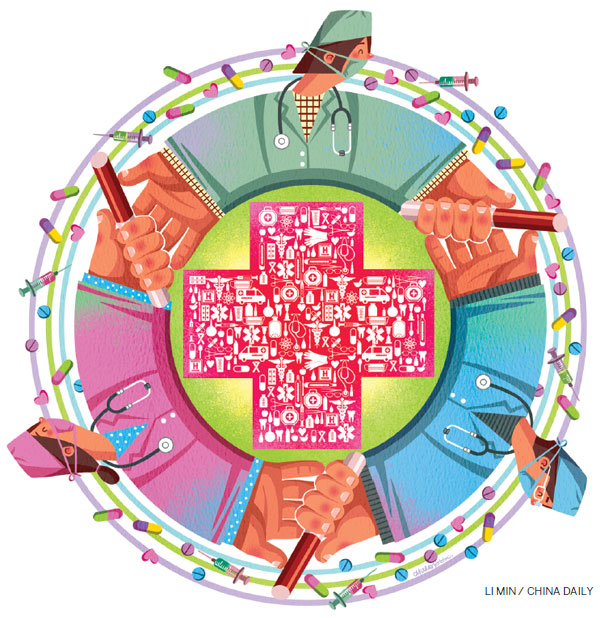
Initiative to facilitate supply of health services, bridge development gap for Beijing, Tianjin and Hebei residents
Medical institutes and human-resource services will be further integrated in Beijing, Tianjin and Hebei province, making life easier for residents of the key city cluster.
The three members of the cluster will recognize each other's medical institutes for insurance reimbursement as well as standard human-resource services, two key aspects to further integrate the unevenly developed region.
The move was confirmed in an agreement signed on Oct 27 by the human resources and social security authorities of the three local governments to promote mutual recognition of their medical institutes and human-resource services.
According to the agreement, those who work or reside after retirement in another city will be eligible for on-site medical insurance reimbursement at 2,188 medical institutes in Beijing and 6,887 in Hebei.
All medical receipts will be reviewed within one day, prior to the establishment of a national platform for medical insurance reimbursement, the agreement said. Before this, patients had to pay the bill first to get receipts, which would be taken to their hometown for reimbursement.
Gao Xiaojun, spokesman for the Beijing Municipal Commission of Health and Family Planning, said in a previous interview that recognizing each other's medical institutes will further facilitate services for those who live and work in different cities.
In March last year, a guideline was released by the central government to integrate Beijing, Tianjin and Hebei to ease the overcrowding of Beijing and promote balanced regional development.
Unlike Yangtze River Delta cities that surround Shanghai, the Beijing-Tianjin-Hebei cluster has developed unevenly for decades. Millions of Hebei residents have been exploring education and employment opportunities in Beijing and Tianjin, two of China's four municipalities that are much more developed economies.
Gao said a survey conducted by his commission found about 23 percent of patients in Beijing hospitals were Hebei residents in 2014.
As of July, 695 million Chinese had basic medical insurance, an increase of 5.7 percent compared to the previous year. However, medical insurance systems in provincial-level regions are still separated from each other.
To overcome this, Beijing, Tianjin and Hebei started to coordinate medical payment reimbursement and training medical professionals in 2014.
Beijing, as the nation's capital with hundreds of prestigious hospitals and thousands of top doctors, has helped Yanjiao, Zhangjiakou, Caofeidian and other cities in Hebei by dispatching experts for surgeries as well as helping to train doctors and nurses at local hospitals.
Yanjiao, a small town in Hebei's Langfang city, is adjacent to Beijing's Tongzhou district near the capital's new governmental seat. The town, just 30 kilometers from Tian'anmen Square, is home to about 300,000 people who work in Beijing, more than 40 percent of its total population.
A pilot program was conducted in the town in 2014 that allows people to choose two local hospitals and two in Beijing for medical-insurance reimbursement. Yang Kaiji, a 30-year-old IT engineer who lives in Yanjiao but works in Beijing, had little spare time during workdays for medical treatment in Beijing but came back to the town during weekends. Thus, he had to take medical receipts back to his company for reimbursement.
"Such a seemingly trivial but factually important procedure" was time consuming, he said. "Now I can get treated and reimbursed at the same hospital either in Yanjiao or Beijing," Yang said.
Moreover, the agreement also stipulates that Beijing and Hebei will have standard operations for human-resource services, with 2,152 human-resource agencies in these two regions able to provide unified services such as talent recruitment, training and archive management.
Medical and human-resource services are vital parts of regional integration, which will enhance residents' lives and make services like medical reimbursement easier, said Xiao Jincheng, a researcher at the Academy of Macroeconomic Research under the National Development and Reform Commission.
"By doing this, the goal of easing Beijing's traffic and environmental burdens will be achieved," Xiao added.