The most accurate clock in the universe
|
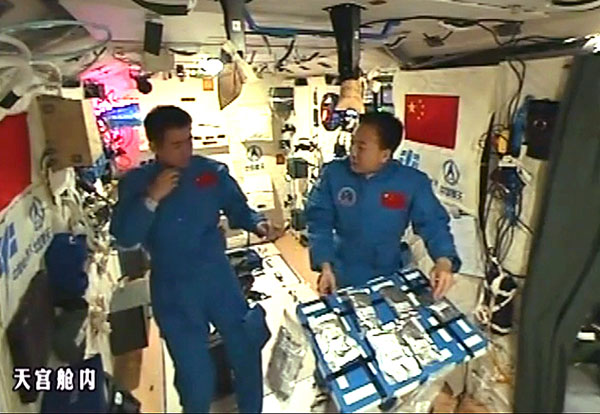 Astronauts Jing Haipeng (right) and Chen Dong display the meals they eat aboard the Tiangong II space lab.Xinhua |
No time to lose
Liu wears a special watch that never loses a second. "It can receive long-wave signals, so it makes an automatic calibration with the National Time Service Center every evening," he said.
That detail sheds light on his quest for accuracy in his life and work.
"All the members of my team demand high standards of accuracy. We never delay meetings, and we always manage to finish our tasks on schedule, even if it means working all night," he said.
He recalled the hardships the team endured when preparing the prototype of the clock. "Time was limited, and there was something wrong with the prototype, but we couldn't discover the reason."
The team spent days, nights and even Spring Festival eve in the lab checking every component and aspect of the prototype, and finally solved the problem on the last day of the stipulated time frame. "It turned out to be a problem with a single magnet," Liu said.
On standby
The cold-atom clock is in standby mode for the 30 days the two astronauts are on Tiangong II.
"That means the main body of the clock has stopped working, and only some parts are still operating," Liu said, adding that the measure ensures the astronauts' safety and the accuracy of the clock's data because the microgravity environment could be affected by human activities.
Liu's team never rests. The members are now accessing their experiences from the last phase of development, and preparing for the next phase, when the astronauts return to Earth and the clock begins working at full capacity.
"The clock has been operating smoothly so far, but making it more adaptable to working in space still poses challenges," Liu said.
In fact, the experiments conducted with the clock in Tiangong II are only the first step in Liu's ambitions.
He plans to put more atomic clocks on a space station China will have established by 2020, which will allow more experiments to be conducted.
The system will combine three atomic clocks: a hydrogen clock; a cold-atom clock; and an optical clock.
Liu noted that timepieces evolved from the sundial of ancient times to the pendulum clock, the quartz clock and later the atomic clock. He predicts that the future will be dominated by the optical clock or even a nucleus clock: "Our ultimate goal is to make a clock that will never be a second fast or slow over the life of the universe."
China Features is a feature department of Xinhua News Agency, which writes indepth stories for overseas readers.





- Is it a thing? 10 odd jobs where you can make good money
- Message on a bottle: Mineral water company launches drive to find missing children
- Sun Yat-sen champion of national integrity, unity: Xi
- Four killed, two injured after house collapses in C China
- Cross-Straits forum held to commemorate Sun Yat-sen