Sand, silt and smooth cordgrass
The Shanghai Chongming Dongtan National Nature Reserve is one of the few reserves scattered across the Yangtze River basin to have made real progress in the restoration of degenerating wetland.
Much of the damage to the wetland - formed by the deposits of mud and sand silt carried by the Yangtze River as it drains into the East China Sea - has been caused by a salt-marsh grass that, despite its green and soft appearance, is killing the landscape, according to Tang Chendong, the reserve's director. Spartina alterniflora, commonly known as smooth cordgrass, is native to the Atlantic coast of the Americas, where it is found in intertidal wetland. It has become notorious as an invasive plant around the world because of its capacity to accelerate the accumulation of sediment and cause the level of the land to rise on the seaward edge.
It was introduced to China in 1979 as an environmental engineering measure. It was intended to catch sediment and allow it to accumulate and prevent coastal erosion.
Since the first plants were discovered in Dongtan in 1995, the grass has spread, and now covers 2,200 hectares of the reserve's 241.55 square kilometers.

"It has led to the loss of habitat and reduction of food resources for our major protection targets - migratory water birds," Tang told a recent meeting of the Yangtze Wetland Protected Area Network in Dali, Yunnan province.
In 2005, the reserve's managers began considering ways of dealing with the plant and started cooperating with universities to identify an ecological way of controlling the spread of the grass and reclaiming wetlands it had already occupied. "Otherwise, we would have become a reserve for smooth cordgrass, not birds," Tang said.
After several years of research and experiments, the managers discovered several ways of dealing with the plant, including building levees around areas overrun by the grass to prevent it from spreading, harvesting the grass, drowning the roots, drying the ground in the sun and growing plants, such as reeds and seawater rice.
"It took us eight years to research and plan the ecological control and restoration project before we formally launched it in 2012," Tang said.
With an investment of 1 billion yuan ($145 million) from the Shanghai municipal government, the four-year restoration project was launched across an area of 25 sq km.
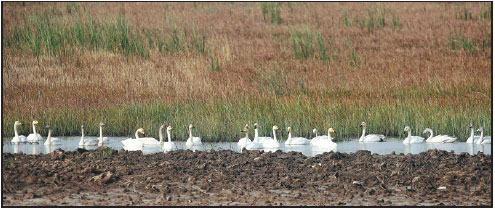
"So far, 99 percent of the smooth cordgrass has been swept out of the area and a 15-sq-km area of open water has been created, which is excellent for the lives of many waterbirds," Tang said. "I was in tears when I watched the wintering birds, including various types of geese and ducks, return to the area this year. That's the biggest reward for our efforts."
Established in 1998, the reserve, at the eastern end of Chongming Island, is a key stopover site on the East Asian-Australasian Flyway. It is important for tens of thousands of migratory waders or shorebirds that breed in Northern Asia and Alaska and spend the non-breeding season in Southeast Asia and Australasia.
So far, 290 species of birds have been spotted at the reserve, 35 of which are under State protection. It is estimated that every year about 300,000 migratory birds will make a stopover at the reserve, which in 2002 joined the Convention on Wetland of International Importance Especially as Waterfowl Habitat - also known as the Ramsar Convention - and was designated World Ramar Site No 1144.
|
A flock of tundra swans at an ecological restoration area in the Shanghai Chongming Dongtan National Nature Reserve.Yuan Saijun / For China Daily |