Bringing justice to the victims of Unit 731
 |
|
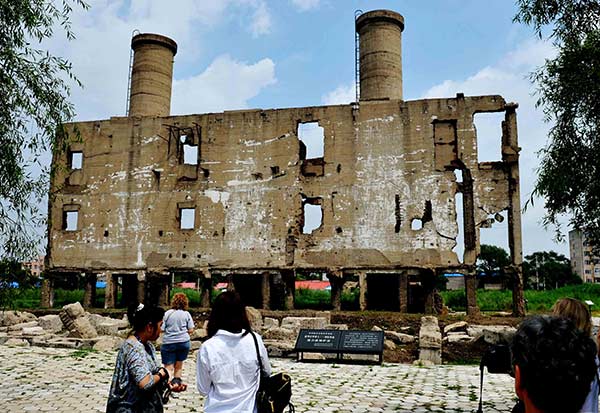
The ruins of the site of Unit 731 in Pingfang, Harbin. WANG JIANWEI/CHINA DAILY |
Humility
"As far as I know, Tsuchiya was the first Japanese to say 'No need to thank us' to the victims," Wang recalled. "His humility was deeply rooted."
In December 1943, with defeat for Japan looming, 20-year-old Tsuchiya left high school and joined the Japanese Imperial Navy. After receiving training in Lyushun, a port in Northeast China, he was dispatched to Chichijima, or "Father", Island, 1,200 meters south of mainland Tokyo, where he endured hunger and constant US bombing until Aug 15, 1945, when Japan formally announced its surrender.
In his autobiography The Spirit of Lawyers, published in Japanese in 2008, the year before he died, Tsuchiya described the death of a fellow soldier. "A bullet shot through his mouth, punching holes in his head and helmet. His eyeballs popped out as blood spurted from his mouth ... a chill rose from the bottom of my heart," he wrote.
Another incident that stayed with him was the execution of a US prisoner of war, 22-year-old second Lieutenant Warren Earl Vaughn, by a fellow soldier and kendo practitioner. Days before the execution, Tsuchiya found time to talk with the young US marine, who was only a year older than himself, and on the night of Vaughn's death, he intervened when two ravenous soldiers attempted to dig up the body and eat it. "I told them that he had died bravely, so they must let him rest in peace. The next day, I reported the incident to my superior, whose reaction was: 'Why stop them?'" Tsuchiya recalled in his book.
"I grew up in an era when conscience was trampled. My own youth was wasted, while many more were cut short," he wrote. "Looking back, I realize that silence in the face of evil is a sin."
Between 1997 and his death at age 86, Tsuchiya, who was highly regarded by his peers, devoted himself to exposing Japan's wartime crimes, in and outside courts of law. His mission took him from Japan to China, where he interviewed witnesses, and to the US and Canada, where he spoke to audiences about the evils of war.
Wang frequently accompanied him. "He would offer to carry my heavy suitcases, something unusual among Japanese men. He was always a steady, fatherly figure," she said. "While in China, he blended easily with the locals, eating and drinking at their homes. Yet he was always such a force in court; concise, powerful and irrefutable."
According to Nishisato, Tsuchiya was not the only former Japanese combatant who came to hate the war they had once avidly fought for their country.
"In 1981, I interviewed Sueo Akimoto, a serologist who had worked at Unit 731 in Pingfang. He told me that Shiro Ishii-the unit's commander and head of the Laboratory of Epidemic Prevention at the Army Medical College in Tokyo-convinced him that he could do 'research' in China," she said. "Akimoto later discovered the truth, but was unable to leave 'the Factory of Death'. When he returned to Japan at the end of the war, he was so ashamed that he chose not to go back into medical service, but to teach X-ray scanning techniques until his retirement."
Not everyone felt guilty, or would admit to feeling so. Kasahara, the microbiologist who performed experiments on humans and became a respected figure in his field after the war, remained unrepentant.
"Believe it or not, during wartime, many Japanese medical professionals felt privileged to be able to go to Pingfang and use human beings in the laboratory," Nishisato said. "They would fill in forms stating how many subjects they wanted to use the next day. The human guineas pigs were referred to as maruta, or "logs", in Japanese.
"Between them, they produced a couple of dozen medical papers, in which the human guinea pigs were referred to as 'Manchurian apes'. Postwar, many received doctorates based on their 'findings' in Pingfang," she added. "I interviewed a few Chinese who did unskilled work in the vicinity of Unit 731's facilities. They said they sensed that something unspeakable must be going on, but they didn't know exactly what it was. Of course they didn't know-it was beyond their wildest imaginings! However, the entire Japanese medical world, more or less, knew during the war."
A sense of denial
Ichinose is aware of how persistent that sense of denial can be. His late father's right forearm and right hip carried scars from the war. "When I was little, I was mesmerized by them. Later, as I grew up, I asked my father: did you ever kill any Chinese?" he said. "Throughout his life, my father, who had studied medieval art history under a leading professor before he joined the army, never answered that question."
Currently, Ichinose is representing 180 victims and their families who are demanding compensation from Japan for the indiscriminate bombing of Chongqing, China's wartime capital. "I don't have unrealistic hopes," the lawyer said candidly, pointing to favorable verdicts given in other cases and, most famously, the case he fought between 1997 and 2007, along with Wang and Tsuchiya. The demand for compensation was rejected, but the court accepted all the facts, from germ warfare to experiments conducted on humans.
"That was a triumph. People in peaceful times must be made fully aware of the cruelty of war," Ichinose said.
In his autobiography, Tsuchiya admitted that he was just one step away from committing a war crime: "The job of beheading the US lieutenant was originally handed to me. Although I hated it, I was in no position to refuse. However, the day before the scheduled execution, I was informed by my superior, who was slightly apologetic, that another person had recommended himself."
When the war ended, the executioner begged his peers not to give him away to US interrogators. Initially, he escaped detection and returned to his hometown, later enrolling at a university in Tokyo. However, in the spring of 1946, news came that the US authorities had discovered the truth and were looking for him. He returned home from Tokyo that night and soon killed himself, according to Tsuchiya's book.
"I was cheated into believing that I was fighting a war of honor, only to realize that there was no honor in being an aggressor-only shame and pain. I could have died a disgraceful and unworthy death; now, I will live for justice until I die," the lawyer wrote.
Contact the writer at zhaoxu@chinadaily.com.cn