Crimes to be punished severely
 |
|
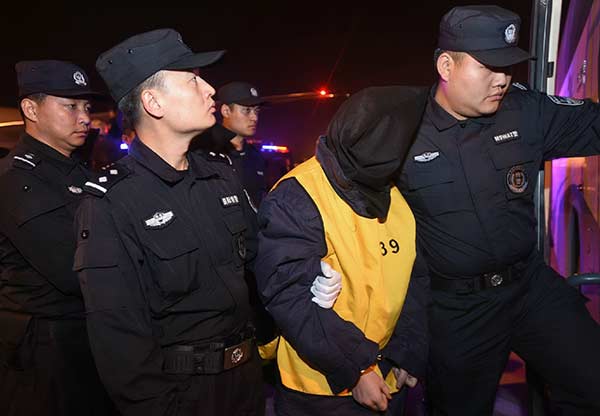
Seventy-four suspects are brought back to Wuhan, Hubei province, in November after Chinese and Malaysian police cracked a telecom fraud case. [Photo/Xinhua] |
Telecom and online fraudsters will face heavier punishments if their behavior causes death or long-term mental distress, according to a new judicial guideline.
The guideline, released on Tuesday by the Supreme People's Court, the Supreme People's Procuratorate and the Ministry of Public Security, stipulates that telecom and online swindlers should be given heavier penalties under 10 circumstances, including causing the death of a victim, cheating the disabled or the elderly, or defrauding by pretending to be legal officials.
"The guideline aims to step up punishments for defrauders or people with such intentions, as the number of cases of telecom and online scams has soared in the past few years," said Li Ruiyi, deputy judge of the top court's No 3 Criminal Tribunal.
From January to November, China uncovered 93,000 cases of telecom and online fraud, catching 52,000 offenders, Li said, adding that both figures had doubled year-on-year.
"Of greater concern is that some telecom scams did not only swindle victims out of money, but also cost them their lives," he said.
In August, Xu Yuyu, an 18-year-old from Linyi, Shandong province, died of a heart attack after losing 9,900 yuan ($1,500) in a phone scam. The money had been intended to cover her college tuition fees.
Song Zhenning, a college student in the same province, also died of cardiac arrest in August five days after he was swindled out of 2,000 yuan.
"The money was intended to cover the victims' tuition, medical and basic living costs. They shouldered both an economic and mental burden," he said, adding that the guideline is to ensure such tragedies are avoided.
Meanwhile, the guideline, effective since Tuesday, unifies a national standard on the definition of fraud amounts.
"Previously, we provided a range for grassroots courts to define how much was considered a 'huge' or 'relatively large' amount, because the economy develops unevenly in different areas," Song said.
But now, in a fraud case, 3,000 yuan or more is defined as a "relatively large amount", while 30,000 yuan or more is defined as a "huge amount", according to the guideline.
Under Chinese Criminal Law, the most severe punishment given to defrauders will be life imprisonment, if the amount of money in a case is "huge" or their behavior is deemed serious enough for such punishment.
Zhou Guangquan, a law professor at Tsinghua University, said: "The more specific the guideline is, the more effective judicial bodies' fight against telecom scams will be."
Chen Shiqu, deputy inspector of the ministry's criminal investigation department, praised the unified standard, "because it makes tackling cross-regional telecom scams much more practical."
caoyin@chinadaily.com.cn
Other major points in the guideline
For cases in which judicial bodies find it difficult to establish how much money has been swindled, they can punish fraudsters for sending text message spam more than 5,000 times or making more than 500 prank calls.
Most telecom scams are gang-related offenses, but in the past, some defrauders escaped punishments due to their undefined roles in such fraud. The guideline states that people providing scam devices or luring others into making payments in calls will be also penalized.
Judicial bodies will focus on tracing money victims have been cheated out of.
Members of a fraud gang who surrender themselves, provide clues for judicial bodies and hand over illicit money of their own accord may be given a more lenient punishment.