Major centers look for ways to cure 'big city disease'
Limited opportunities
This apparently simple solution is proving problematic, though, because the government has only lifted the registration requirements in third - and fourth-tier cities, which offer limited job opportunities and public resources.
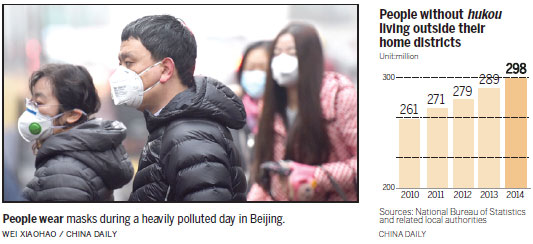
The lack of facilities and limited opportunities mean lower-tier cities are rarely attractive enough to tempt people to settle in them.
Meanwhile, the nation's larger cities, those that provide higher levels of education and medical care as well as better jobs, are tightening their policies on household registration to control population growth.
The Beijing municipal government plans to cap the city's population at less than 23 million by 2020, which will see the permanent populations of six major downtown districts reduced by 15 percent. The government estimates that the city's permanent population was 21.7 million at the start of this year.
Meanwhile, Shanghai plans to plateau its population at less than 25 million people by 2020. According to data from the National Bureau of Statistics, about 24 million people were living in the city in 2014.
Both Beijing and Shanghai have imposed limits on the approval of land for construction and are working to move a number of non-core sectors, such as heavy industry, outside the city limits.
To limit the scale of the city, Beijing has forbidden approvals for residential construction on land within the Fifth Ring Road, and by 2020, the total area earmarked for construction projects should be reduced to 2,800 square kilometers.
Yu Hongsheng, head of the cities and population development institute at the Shanghai Academy of Social Sciences, believes that the area of construction land is in lockstep with a city's population.
"At present, the urbanization of land is moving faster than the urbanization of the population, while the latter is faster than industrial urbanization. The situation has caused a waste of construction land and very low land-usage efficiency," Yu said, in an interview with the 21st Century Business Herald.
"For cities like Beijing and Shanghai, reducing the area of land available for residential construction is an important way of controlling the population, especially the number of residents who have hukou in other locations," he said.