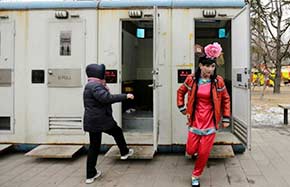
'Toilet revolution' in revolutionary heartland
JINGGANGSHAN, Jiangxi province -- For decades, Xie Fengzhen and her family answered the call of nature in a smelly pit toilet full of flies and maggots near her house.
"Every time I stepped outside the toilet, my clothes just gave off a disgusting smell," said Xie, 62, from the remote Maoping Village in Jinggangshan City, the heartland of the Communist Party of China's early revolutionary activities in east China's Jiangxi Province. "In winter, it was freezing cold in the ramshackle hut."
Toilets in the Chinese countryside have earned a nasty reputation, with some little more than shabby shelters surrounded by bunches of cornstalk and others just open pits next to pigsties. China's national standard requires "sanitary" toilets in rural homes to have walls, roofs, doors and windows and to be at least two square meters in size. They may be flush toilets or dry toilets with underground storage tanks.
A "toilet revolution" spearheaded by the local government has helped residents like Xie in Jinggangshan bid farewell to old latrines. The Jinggangshan government has allocated more than 30 million yuan ($4.3 million) for 562 villages to help renovate sub-standard rural toilets in recent years.
According to latest government figures, a total of 16,865 toilets have been upgraded so far, benefiting some 75,000 villagers.
"The rural toilet revolution is out of consideration for sanitation and rural tourism development," said Zeng Zhaojun, head of Maoping township, which administers Maoping village.
According to Zeng, traditional dry toilets, which were basically a pit under two wooden planks, were susceptible to mosquitoes and bugs as they were exposed to the open air for a long time. Meanwhile, they also risked polluting the water and soil.
Zeng added that in the past, people in rural China did not have enough drinking water for themselves or domestic animals.
"People used to trek mountain roads for kilometers to fetch spring water high in the mountains," Zeng said. "Under such circumstances, who would ever think about installing flush toilets to waste precious water?"
The official said that locals would use the excrement from dry toilets as fertilizer for the fields, which saved money.
But as life has improved in Jinggangshan in recent years, most farmers have switched to chemical fertilizer. Additionally, most families have tap water now. These changes have made it possible to upgrade toilets in rural areas.
Meanwhile, rural tourism in gaining steam in Jinggangshan, where visitors come in admiration of the city's revolutionary history and amazing mountain views. Last year, the city received close to 14 million tourists, creating demand for basic facilities in rural areas.
Toilets play an important part in shaping the image of a tourist spot, particularly in Jinggangshan, where a huge number of visitors come each year, Zeng said.
"To accommodate tourists, clean toilets are necessary," said Li Zhonglin, former Party chief of Bashang Village in Maoping Township. "You don't want them to have a bad impression."
The city government has demanded a toilet transformation in its villages before tourism projects are launched. It also provides subsidies to the rural population to upgrade their toilets. In 2006, the subsidy was 600 yuan for each toilet overhauled. This year, the amount has risen to 1,000 yuan.
From 2004 to 2013, China's central government earmarked 8.27 billion yuan to build toilets in rural areas. Farmers who have agreed to build new toilets are eligible to receive the funds. The amounts vary from 150 yuan in central and western China to 500 yuan in eastern and southern regions, where building materials are more expensive. Local governments with deeper pockets may also offer additional subsidies to villagers.
By Nov 15 this year, China had built or renovated 39,393 toilets in tourist areas, accounting for 69.11 percent of the three-year target set in 2015.
According to a nationwide survey by Tsinghua University, tourists gave toilets in China's tourist areas a score of 70 out of 100. According to the survey, most of those surveyed think that the national "toilet revolution" has "basically improved toilet quality" and "met the demands of tourists."
The toilet revolution in Jinggangshan has greatly improved Xie Fengzhen's quality of life.
Her new bathroom is no more than five square meters, but it has a flush toilet, a shower and a washbasin. The room also has shining ceramic tiles.
"I am just happy that my family no longer needs to endure those nasty pits," said Xie.