Master craftsmanship in the Forbidden City
 |
|
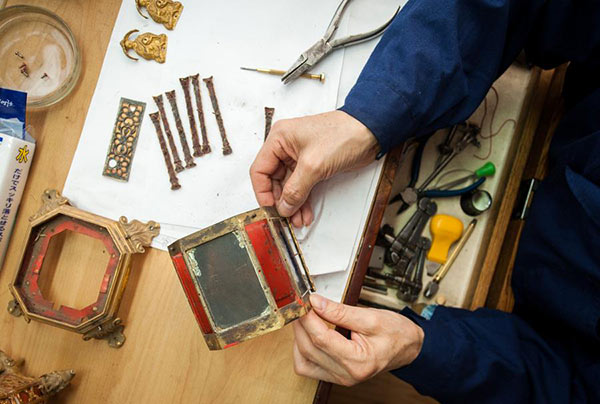
A craftsman dismantles a timepiece before repairing it in their office in the Palace Museum in Beijing, April 7, 2016. [Photo/Xinhua] |
BEIJING - Working in the Palace Museum where visitors are constantly told not to touch the invaluable cultural artifacts, Qu Feng spends every day in restoring treasures dating back hundreds of years.
Qu works for the Palace Museum's conservation department, which is responsible for the conservation, restoration and research of over 1.8 million cultural treasures.
Stories of treasured Chinese antiques and artifacts given a new lease of life emerge constantly from his busy department.
Qu and his colleagues are now better known as the "masters in the Forbidden City."
MASTERS IN THE FORBIDDEN CITY
Qu, head of the department's wood conservation studio, is working on a piece called "Plum Recess," a wooden plaque inlaid with gold wire and two jade characters.
The plaque, made during Emperor Qianlong's reign (1736-1795), once hung inside the Forbidden City's Hall of Mental Cultivation, where emperors of the Qing Dynasty (1644-1911) resided and handled state affairs.
When the hall was closed for a four-year renovation, the plaque was removed for conservation.
Some of the plaque's jade had fallen off; sticking it back proved far more difficult than anyone expected.
Qu had to use a special type of wax, made of beewax and rosin, as other adhesives could corrode the jade over time. The recipe to produce this special wax had once been lost, and the museum depended exclusively on the wax it had in stock.
After years of effort, the conservation department managed to reconstruct the recipe through chemical analysis.
However, even with all the right ingredients on hand, Qu and his team still had to wait, as the old, frail plaque and its frame had been partially damaged by expansion and contraction caused by heat.
"If it is restored now [in winter], thermal expansion may cause even greater damage next summer," Qu said.
Earlier this year, "Masters in the Forbidden City," a documentary series that profiled the work of the museum conservationists, became a surprise online hit. It has racked up over six million views and scored an impressive rating of 9.5/10 on a major video-streaming website in China.
A film version was released on Dec 16, on the heels of the TV series' success.
The conviction, inner peace and persistence of the technicians have made them heroes among many of China's post-80s and post-90s generations.
SPIRIT OF CRAFTSMANSHIP
According to Shan Jixiang, director of the Palace Museum, the documentary's popularity resulted in a surge of applications for jobs with the restoration team.
This year the museum received 15,000 job applications for 20 vacancies.
However, becoming a qualified conservation worker takes time.
Wang Hongmei specializes in restoring tarnished paintings that are often disfigured by stains, mold and holes.
First coming to the museum to build on her knowledge of the essence of Chinese culture, Wang, who draws exquisite classical Chinese paintings, has worked in the museum for 16 years.
"I found conservation of paintings extremely challenging at the beginning when I often had to stand for hours all day long due to the nature of the work," Wang recalled. "Commitment and time gradually calmed down my heart."
It takes a seasoned conservationist like Wang a whole year to restore just three to four paintings. Sometimes the work could take even longer.
A scenic painting over 170 square meters in size, depicting purple wisteria, cranes and pines, was posted to the wall and ceiling of the Studio of Exhaustion from Diligent Service, commissioned by Emperor Qianlong for his retirement.
Fashioned under the guidance of Jesuit missionary and artist Giuseppe Castiglione, it is an exceptional painting.
From 2003 to 2008, Wang and her colleagues spent five years restoring the tattered painting to its previous brilliance.
The craftsmanship required for such work pushes conservationists to their limits and becomes a process of self-discovery, said Qu, who has spent 10 years within the Forbidden City's red walls.
"When it comes to conservation, one has to have patience, learning and dexterity," Qu said, adding that a qualified craftsman must love his work, toil tirelessly and stay humble and informed.
The public now has a chance to glance into this painstaking and once mysterious profession.
The Palace Museum unveiled a conservation workshop Thursday, which will enable the public to observe first-hand how the museum goes about its conservation of China's cultural heritage.
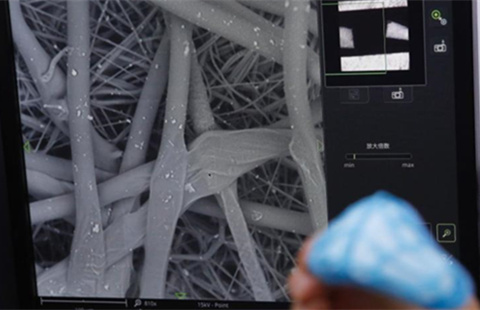
The workshop, a new site of the museum's conservation department, is currently the largest cultural heritage conservation center in China. It uses traditional techniques but is also equipped with advanced scientific facilities.
It conserves relics, including textiles, wood, lacquer, ceramics, metal, clocks, books, Thangka and murals. It also replicates calligraphy and painting.
The workshop, named the "Hospital for Conservation," will open to the public on an appointment basis.
The museum hopes to further spread understanding of cultural heritage protection, Shan said.
LEGACY FOR THE FUTURE
"The Hospital for Conservation is the first major conservation center in China to offer access to the public," Wang said, noting the importance of passing on such craftsmanship to future generations.
"It helps spread respect for Chinese craftsmanship and heighten public awareness of traditional Chinese culture," she said, adding that the public's presence would also be a welcome source of motivation for her at work.
"The Palace Museum treasures are not simply individual items, but legacies of the craft and spirit passed on by the artists, collectors and conservationists of the past," Qu said.
"Strengthened conservation efforts symbolize increasing national power and pride. If we can protect our cultural heritage to the best of our abilities, our nation will come to believe in itself more firmly," Qu said.