Earthquake monitoring network set
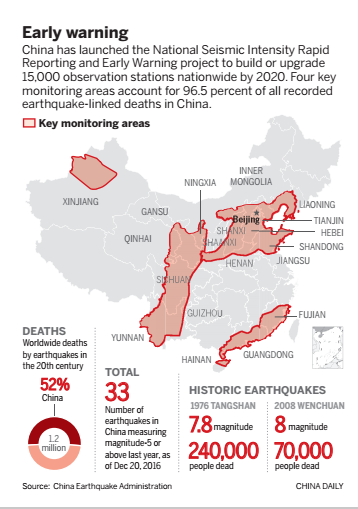
An earthquake early response and warning system, consisting of about 15,000 observation stations, will cover the mainland by 2020, to facilitate disaster identification and the protection of people's lives, vital infrastructure and utilities.
Such stations will be spaced 13 kilometers apart in key monitoring areas that span 200 square kilometers in North China, along the southeastern coast, in northwestern Xinjiang and along the so-called North-South Seismic Belt that encircles most of Sichuan, Gansu and Yunnan provinces, said Zheng Guoguang, new administrator of the China Earthquake Administration.
The stations will be built on average 47 km apart in other areas, Zheng said in an exclusive interview.
The National Seismic Intensity Rapid Reporting and Early Warning project is the largest of its kind in the world, he said.
"We are expected to be able to alert people within seconds following a destructive earthquake measuring 5 or above on the Richter scale, and to release within minutes its intensity distribution," said Zheng, who previously was administrator of the China Meteorological Administration.
It is much more challenging to try to forecast earthquakes, he said. At least 33 percent of the world's continental earthquakes have occurred in China.
Completion of the mammoth project, with startup investment of 2 billion yuan ($290 million), will make it easy to rapidly pinpoint earthquake-afflicted areas, assess disaster situations and implement contingency plans, he said.
Zheng said the country's earthquake preparedness and disaster relief efforts should serve public security and national strategies, such as the Belt and Road Initiative, coordinated development of Beijing, Tianjin and Hebei, and building of the Yangtze River Economic Belt, all of which include development of city clusters.
This year, to help with the Belt and Road Initiative — an infrastructure and trade network connecting Asia with Europe and Africa along ancient trade routes — Zheng's agency will help Nepal and Laos build seismic stations and begin construction of the China-ASEAN Earthquake and Tsunami Monitoring and Early Warning System.
Meanwhile, Zheng, citing the Earthquake Prevention and Disaster Mitigation Plan (2016-20), also disclosed that in the next five years, earthquakes measuring magnitude-7 or above on the Richter scale are likely to continue in the country's vast western regions, while quakes measuring magnitude-6 or above are likely to strike the country's eastern parts.
The policy document, part of the country's 13th Five-Year Plan, was released by the China Earthquake Administration and the National Development and Reform Commission in November.
It warns that some city clusters are located near where strong earthquakes are likely to occur, and seismic risks exist in some key areas where the national strategies are being carried out.
"It could be extremely hazardous if earthquakes hit areas with supporting infrastructure and projects, such as nuclear and gigantic petrochemical projects and high-rise dams," the policy document says.
Zheng said that during the planning phase, for city clusters in the risk areas, anti-seismic design has been "fully factored in" and anti-seismic design standards have been set for the construction of nuclear, power and other major projects.
After a decade of preparation, a new national seismic hazard map went into use in June as part of setting mandatory national standards for safer structures, according to Zheng.
He said he expected that the Fifth Seismic Hazard Map of China will be implemented to the letter, in an effort to ramp up earthquake preparedness in cities as well as rural areas.
Only 6 percent of all houses have met anti-seismic design requirements in China's rural areas, while in recent years, 60 percent of earthquake victims were rural residents, according to statistics of the China Earthquake Administration.
"Houses will be either retrofitted or rebuilt for at least 18 million farmers by 2020," Zheng said.