Older couples struggle with infertility when seeking second child
 |
|
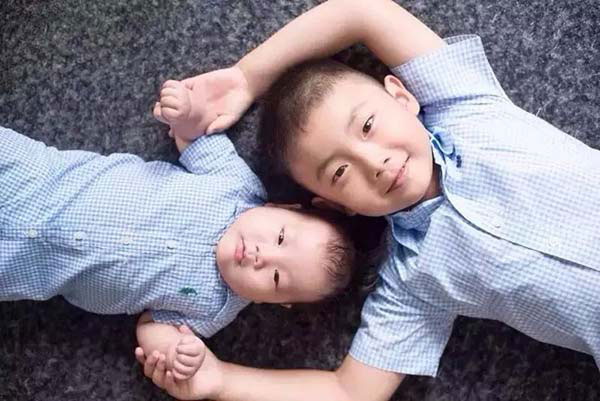
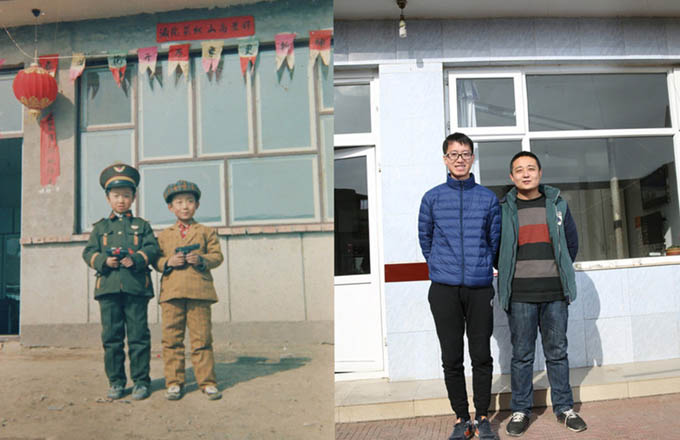
A boy with his younger brother. [Photo provided to chinadaily.com.cn] |
After the implementation of the universal second-child policy early last year, many Chinese parents are considering another baby. However, several are facing an even greater challenge than the time and money demanded by a newborn baby -- infertility.
Nearly 90 percent of Chinese women over 45 years old are infertile and the average age of their last pregnancy is 40, according to a report by People's Daily. On the other hand, many Chinese husbands also find themselves lacking quality sperm.
Data shows that 90 million women of child-bearing age are affected by the policy change. Yet 60 percent of them are 35 or older, while 50 percent are over 40.
Geng Linlin, deputy director of the clinical medicine center at the National Health and Family Planning Commission, says that infertility is becoming the greatest challenge for couples who have the economic capability and desire to have more than one child.
Geng says that human fertility deteriorates with age. In addition, environment pollution, exposure to electromagnetic radiation and chemicals further damage women's ability to conceive and reproduce.
In recent years, China has witnessed a rocketing number of older pregnant women. The proportion of pregnant women who are over 35 years old was 0.9 percent in 1995, four percent in 2005 and 10 percent in 2015.
Mothers with a uterine scar from earlier cesarean section face risks during a second childbearing. As the fetus grows bigger during late pregnancy, sometimes a uterine rupture may occur that could be life-threatening, Geng Linlin cautions.
Lu Qun, chief physician and professor at the reproductive center of the People's Hospital of Peking University, says age plays an important role in childbearing because it determines the quantity, as well as quality, of ovaries. Not only does advanced age reduce the chance of fertility, it also significantly increases the possibility of congenital deformities and miscarriage.
Decreasing fertility has become a serious issue all over the world. A report by the World Health Organization (WHO) shows that an estimated 15 to 20 percent of couples worldwide suffer from infertility and that number in China is about 15 million, says Wang Lina, an obstetrician at Peking University Third Hospital.
Moreover, 15 percent of pregnant Chinese women experience a miscarriage. One-third of those who've previously had a miscarriage miscarry again. Meanwhile, among the women who give birth, 5.6 percent of the newborns have a birth defect — twice the rate of developed countries. Mothers over the age of 35 see birth defect rates of 8 to 15 percent in their newborns.
Another concern for older parents is poor sperm. Previous surveys suggest that the number and quality of Chinese men's sperm have been decreasing greatly, mainly resulting from the pressure of modern life.
Higher infertility rate and simplified government-approval process prompt a growing number of older couples to use assisted reproductive treatment such as frozen semen and eggs, and test-tube babies. Last year, a 64-year-old woman in Northeast China's Jilin province gave birth to a healthy boy after receiving in vitro fertilization.
Another attractive way for older couples is to seek surrogacy, which is illegal in China although experts suggest that the law should be adapted to give couples more opportunities.
Wang Lina believes that keeping surrogacy services illegal, especially for patients who have had their uterus removed due to diseases, deprives women of their right to be parents. The government should consider loosening the ban on surrogacy while preventing commercialization of the practice.
"Though many couples may have lost their reproductive capacity, their sperm and ovaries may still be viable. They should be supported emotionally to have another offspring. Ethics in this case should not become a burden but a tool in promoting the orderly development of surrogacy services,” says Wang Yifang, a professor at the Institute of Health and Humanities at Peking University.


- Older couples struggle with infertility when seeking second child
- E-commerce gives capital's Spring Festival sales a boost
- China invites journalists to cover political meetings
- 2 rescued, 7 dead in China home collapse
- Massive crowds take over scenic spots across China during Spring Festival