Humanistic spirit drives Sino-Thai ties
|
 |
|
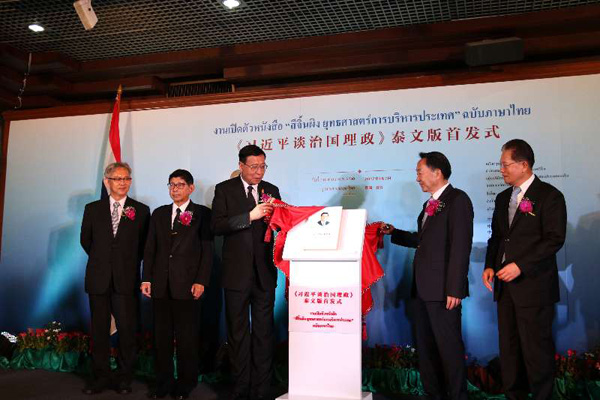
Jiang Jianguo (second right), minister of the State Council Information Office and Thai Deputy Prime Minister Wissanu Krea-ngam (third right) attend the launching ceremony of the Thai language edition of the book Xi Jinping: The Governance of China in Bangkok April 7, 2017. [Photo provided to chinadaily.com.cn] |
If we read this book, we can find that President Xi's thoughts on China's governance are full of rich humanistic spirit. Where does such kind of humanistic spirit come from?
First, it comes from President Xi's deep love for excellent traditional Chinese values and concepts. Politicians and thinkers in ancient China accumulated a lot of political wisdom on the world's governance, created an ideological system that put stress on love, people, integrity, justice, and harmony and solidarity, and left to their offspring a series of cultural classics and valuable books such as the Collection of Ancient Texts, Book of Rites, Analects of Confucius, and Doctrine of the Mean.
President Xi holds deep love for excellent traditional Chinese cultures, and has extensively read ancient classical books and gained full knowledge of ancient and present-day society. With creative conversion and innovative enrichment of traditional Chinese cultures, President Xi has formed, enriched and developed his thoughts on the governance of China. It is the excellent traditional Chinese cultural essence that has nourished his humanistic spirit.
Second, it comes from President Xi's high degree of confidence in the socialist advanced cultures of China. President Xi not only loves excellent traditional Chinese culture, but also has full confidence in the advanced culture created by the CPC in its practices of building the nation. The root of traditional Chinese cultures is the people, and the basic position of Marxism is the "masses". The combination of the two spirits has helped the CPC form its own purposes.
People interested in China may find an interesting phenomenon, that is, the initial and latest fruits of the Sinicization of Marxism are both related to "cave dwellings" in the northwest of China. In September 1944, Chairman Mao Zedong put forward the "serve the people" thought in a cave dwelling in Yan'an, Northwest China's Shaanxi province. At a young age, Xi lived for seven years in a cave dwelling in Yan'an, nurturing his deep feelings toward the people. "Marxism in cave dwelling" is in essence a people-first and people-centered outlook. President Xi's words that "people's yearning for a better life is the goal of our struggles" exactly embodies his confidence in Chinese culture.